Best overall
PODS
4.5
5,408 reviews
- Monthly rent
- $389
- Other fees
- $149 for delivery; $149 for redelivery
- Contracts
- Month-to-month
- Availability
- 44 states, Washington, D.C., Canada and U.K.
PODS, CubeSmart, Public Storage and Extra Space Storage are our top picks






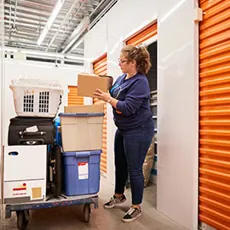
Self-storage units offer an easy way to store belongings that don’t fit in your home during a move, renovation or life transition. But it’s important to understand your options before choosing a facility.
The biggest differences between our top picks come down to their service models. PODS brings the container to your home, lets you load on your own time and then either leaves it on-site or takes it to a storage center or another destination. CubeSmart, PublicStorage and Extra Space Storage work the opposite way: You choose a facility, transport items there yourself, unload into a unit and repeat the process at move-out.
To select our top picks for this guide, we compared storage companies based on customer reviews, pricing, unit selection, amenities and contract flexibility to identify the best options for different storage needs. Our picks may be Authorized Partners that compensate us, but this does not affect our recommendations or evaluations. Read our full methodology for more details.
| Company | Our pick for | Monthly rent | Month-to-month contracts | Availability | |
|---|---|---|---|---|---|
 PODS | Learn More | Best overall | $389 |  | 44 states, Washington, D.C., Canada and U.K. |
 CubeSmart | Learn More | Value | $71.40 | | Most states |
 Public Storage | Learn More | Flexibility | $146 | | Most states, Europe |
 Extra Space Storage | Learn More | Customer service | $204 | | Most states |

The ConsumerAffairs Research Team evaluated storage companies using a weighted scoring system that combined customer feedback with key storage features and pricing information.
We analyzed verified reviews submitted to ConsumerAffairs from June 1, 2023, through May 31, 2026, to identify the factors that matter most to storage customers. We measured satisfaction with:
We also examined review volume and company responses to reviews.
We compared the features shoppers are most likely to consider when choosing a storage provider, including:
We also looked at conveniences such as climate-controlled units, drive-up access, mobile storage containers, security features and other storage perks.
Each company received a score for every factor, and those scores were weighted differently depending on the category. For example, “Best value” placed more emphasis on costs and amenities, while “Best storage flexibility” focused more heavily on unit selection and contract terms. The company with the highest score in each category earned our recommendation.

Jump into our guides and start learning
Whether you need a temporary storage solution to help streamline a move or you’re looking for a monthly storage plan that lets you store your items on a more long-term basis, there are convenient storage options across the U.S. to fit your size and budget needs.
Choosing between indoor and outdoor storage depends largely on what you’re storing and how often you’ll need access, with climate control and drive-up convenience being two of the biggest deciding factors.
Jump to insightA 10-foot-by-10-foot unit is considered the industry standard. It balances affordability and space, typically fitting the contents of a one-bedroom apartment while still accommodating larger furniture pieces.
Jump to insightMonthly storage costs can vary significantly by location and features, so comparing base rates, promotional offers and potential add-on fees is essential to avoid paying more than expected.
Jump to insightWhen selecting a storage unit, you have a few options. There are indoor and outdoor units, both of which offer a variety of features and add-ons.
Storage units are measured in square feet. They typically range from 5 feet long up to 30 feet long. A 5-foot-by-5-foot storage unit is about the size of a closet, while a large 10-foot-by-30-foot unit is larger than the average garage and can fit the items from a furnished three-bedroom home, including appliances and boxes.
To select the right size, match your specific belongings to unit dimensions and consider how often you'll need to access items.
| About the size of | Fits | ||
|---|---|---|---|
| Small closet | Small sofa or armchair, dresser, mini-fridge, 10 to 15 boxes, seasonal storage bins | ||
| Average walk-in closet | Queen mattress set, small dining set, bookcase, bicycle, 15 to 25 boxes | ||
| Large walk-in closet | Mattress set, loveseat, desk, multiple small furniture pieces, 20 to 30 boxes | ||
| Half of a one-car garage | One-bedroom apartment contents including mattress set, couch, dining table, multiple dressers, 25 to 40 boxes | ||
| One-car garage | Multi-room home contents including large furniture, appliances, garage equipment, several mattresses, 60+ boxes | ||
| Larger than a one-car garage | Three-bedroom home contents, oversized furniture, appliances, garage items, business inventory, 70+ boxes | ||
| One-and-a-half car garage | Four- to five-bedroom home contents, large appliances, patio furniture, vehicles or commercial equipment, 80+ boxes |
The typical cost for a storage unit ranges from $90 to $290 a month based on the size of the unit, facility location and facility features. It's important to compare prices and look into any additional fees that could arise.
Additional fees that you should also expect include:
Some self-storage companies offer discounts for college students and military personnel. Many also run various promotions and discounts for storage.
Different facilities may vary in what they offer. For climate-sensitive items, CubeSmart and Extra Space are the safest choices on paper because both offer 55- to 80-degree climate-control range. Public Storage offers outdoor, covered and enclosed vehicle storage, plus some 24/7-access locations, but availability is somewhat limited.
In general, we recommend looking for storage companies that have:
Without a doubt, the hardest part about using a storage unit is move-in day. Moving requires supplies and resources you may not have or know you need. These services aren’t available from every facility but can definitely help make the move-in process easier.
Renting a storage unit follows a straightforward process whether you complete it online or at the facility.
Facilities offering online move-in or skip-the-counter service provide the fastest start, with access codes and unit assignments ready upon arrival.
There are numerous size options for storage units, but the industry-standard storage unit size is 10 feet by 10 feet.
Some renters and homeowners policies extend personal property coverage to items stored off-premises, typically with reduced limits. Coverage depends on your insurer, policy type and cause of loss. Contact your agent to confirm off-premises coverage, limits and deductibles.
Many storage facilities charge an administrative fee at move-in and may require a security deposit, though policies vary by company and location. Always review your rental agreement carefully to understand upfront costs.
Introductory rates and promotions, such as the first month free or discounted, often apply only for a limited time. After the promotional period ends, your monthly rate may increase based on market conditions and facility policies.
Top storage facilities typically offer gated access, personalized entry codes, 24/7 video surveillance, well-lit premises and secure locking mechanisms. Some locations may also have on-site staff for added oversight.
Most facilities prohibit storing hazardous materials, flammable liquids, explosives, perishable food, live animals and illegal items. Check with your specific facility for a complete list of restricted belongings before moving in.
Information in this guide is general in nature and is intended for informational purposes only; it is not legal, health, investment or tax advice. ConsumerAffairs.com makes no representation as to the accuracy of the information provided and assumes no liability for any damages or loss arising from its use.
Thanks for subscribing.
You have successfully subscribed to our newsletter! Enjoy reading our tips and recommendations.
| Company | Customer rating | About | Learn More |
|---|---|---|---|
 Colonial Van Lines
| 4.3
2,989 reviews
| Tailored moving services. Professional, experienced movers. Commitment to customer satisfaction, transparent pricing and a track record of reliable service. Moves out of state. Backed by years of expertise. | Get a Quote |
 WayForth
| 4.8
99 reviews
| Residential and business interstate and intrastate moving company. Licensed and insured. Services range from basic to full-service, comprehensive moves. Available nationwide. Specializes in senior moves. | Read reviews |
 SpareFoot
| 1.0
View profile
| Price comparison for self-storage, car storage, RV and boat storage. Offers free online reservations with no credit card. Deals on storage fees, portable storage and moving trucks. Facilities throughout the United States. | Read reviews |
|
PODS
| 4.5
5,408 reviews
| Provides residential and commercial moving and storage solutions. Offers various container sizes. Local moves tend to cost about $500. Most long-distance moves cost between $1,000 and $3,000. Month-to-month pod rental. | Read reviews |
 U-Pack
| 3.5
32 reviews
| Provides movable storage boxes you pack and unload yourself. Handles moves of at least 100 miles. Offers free quotes and flexible storage options. Does not offer services for local moves. Typical moves cost from $500 to $2,500. | Read reviews |
|
Public Storage
| 2.5
1,535 reviews
| Offers storage units for personal, business and vehicle storage. Thousands of locations nationwide. No long-term commitment required. Climate-controlled facilities available. | Read reviews |
|
CubeSmart
| 2.1
263 reviews
| Offers no-commitment reservations. Monthly leases - no annual contract. Customers can lock in a reservation without a payment method. | Read reviews |
 1-800-PACK-RAT
| 2.0
455 reviews
| Pack a container at your own pace for moving or storage. Offers local and long-distance moving. Ships moving supplies to your door. Multiple protection plans to insure your belongings. Available in 97% of the U.S. | Read reviews |
 Zippy Shell
| 1.8
67 reviews
| Moving company offering self-storage and moving containers. DIY and full-service portable units. No hourly rates. 3-day loading periods. Units can fit on sidewalks, driveways and city streets. | Read reviews |
 Extra Space Storage
| 1.7
847 reviews
| Self-storage facilities across the U.S. Climate-controlled units available. Boat and RV storage options. Online rental and payment systems. Multiple unit sizes and flexible storage options. | Read reviews |
 Clutter
| 1.7
463 reviews
| Offers moving and storage with tech-powered convenience. Benefits include pre-move digital walkthroughs, an online storage catalog, truck tracking and online move management. Available in parts of CA, IL, NJ, NY and WA. | Read reviews |
 NSA Storage
| 1.5
67 reviews
| With locations in ten states across the United States, iStorage Self Storage is a self-storage company offering consumers storage space with upgraded amenities, such as free Wi-Fi and top-of-the-line security. | Read reviews |
 Simply Self Storage
| 1.5
59 reviews
| Offers a variety of self-storage solutions. Depending on the need and budget, consumers can choose from various unit sizes including mini storage, outdoor RV and boat storage. | Read reviews |
 U-Haul Storage
| 1.0
160 reviews
| Provides U-Box portable storage containers for moving and storage. Each U-Box has a capacity of 257 cubic feet, and you can order multiple boxes to fulfill your job. International shipping available. | Read reviews |
 SMARTBOX
| No reviews | Provides assistance for local, long-distance and corporate moves, plus portable storage units for rent. Seasonal, temporary and long-term storage options available. | |
 Door-to-Door Storage
| No reviews | Door-to-Door storage was acquired by U-Haul in May 2017. | |
 Go Mini's
| No reviews | Available in three sizes: 12 feet, 16 feet and 20 feet. Containers are available for both moving and storage. Specializes in local moves and military moves. Store your containers on your property or at a Go Mini’s facility. | |
 United Mayflower
| No reviews | Offers portable moving and storage containers in more than 50 markets in the United States. Moving and storage experts available seven days a week. | |
 WillScot
| No reviews | Provides portable construction storage containers with 80 locations across North America. Shelving, pipe racks and security features available. Offers large units up to 40 feet by 8 feet. |