How Many Americans Own A Smartphone? 2026

+3 more




Between landlines, cell phones and smartphones, new data proves that smartphones are the preferred method of communication among people of all ages. In 2024, an estimated 91% of Americans owned a smartphone. How essential are they, and how much time do we spend on them? To understand more about the state of smartphones, let’s review the numbers.
In 2024, 91% of individuals in the U.S. owned at least one smartphone.
Jump to insightiPhone’s quarterly market share was about 58.2% in Q3 of 2025, up more than 2.6 percentage points from 2024’s Q3.
Jump to insightOn average, most children receive their first smartphone at age 11.
Jump to insightAs of 2025, American adults spend an average of five hours and 16 minutes on their mobile devices each day, not including time spent speaking on the phone.
Jump to insightAs of Q1 in 2023, about 45% of all web traffic in the U.S. originated from smartphones.
Jump to insightGeneral smartphone statistics by year
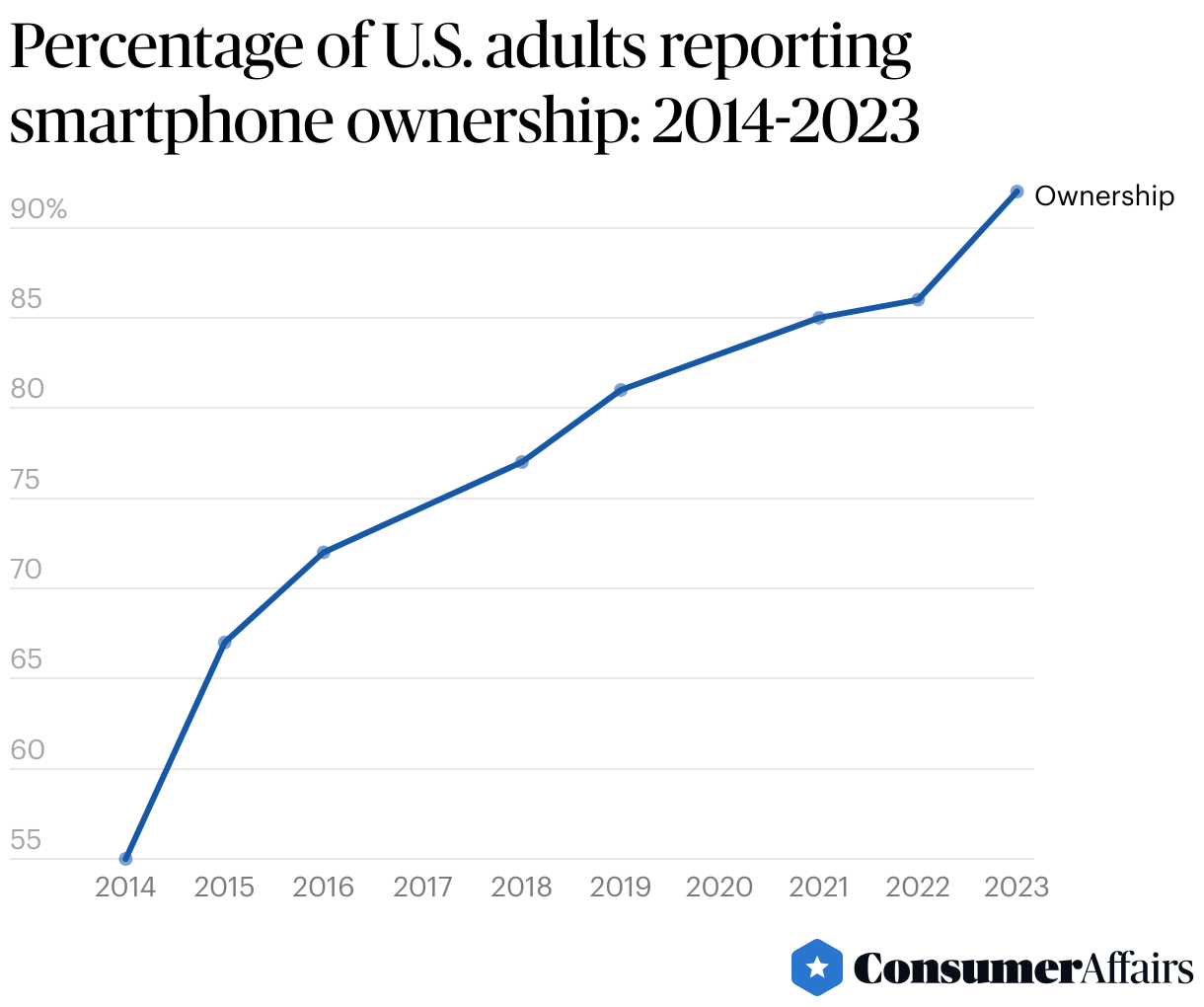
Smartphone usage has increased steadily over time. Between 2014 and 2024, the percentage of U.S. adults who reported owning a smartphone increased by more than 65%.
Ownership demographics
As of 2024, there were over 310 million smartphone users in the U.S.
Age
Adults between the ages of 18 and 49 are the most likely to own a smartphone (97.5%). After the age of 49, smartphone ownership decreases with age; only 79% of adults ages 65 and over own a smartphone.
| Age | Percentage of U.S. adults who own a smartphone |
|---|---|
| 18 to 29 | 98% |
| 30 to 49 | 97% |
| 50 to 64 | 91% |
| 65+ | 79% |
Race/ethnicity
Smartphone ownership among adults in the U.S. varies based on race and ethnicity. While 92% of white Americans and Hispanic Americans own a smartphone, only 87% of Black Americans are smartphone owners. In the U.S., 95% of Asian Americans own smartphones, though this does not account for Asian Americans who do not speak English.
Income
The likelihood of smartphone ownership increases with income. 84% of U.S. adults with an annual income of less than $30,000 own a smartphone. This figure jumps to at least 93% among Americans making $30,000 or more.
| Annual household income | Percentage of U.S. adults who own a smartphone |
|---|---|
| <$30,000 | 84% |
| $30,000 to $69,999 | 89% |
| $70,000 to $99,999 | 95% |
| $100,000+ | 96% |
Education level
Smartphone ownership also increases with educational attainment.
- Among those with a high school diploma or less, 85% own smartphones.
- Among those with at least some college education, 94% own smartphones.
- Among those with a college degree or more, 95% own smartphones.
Smartphone internet usage statistics
As of Q1 in 2023, about 45% of all web traffic in the U.S. originated from smartphones, and roughly 15% of adults used their smartphones to access the internet at home, having no broadband access or subscription.
Smartphone dependency
The term “smartphone dependency” refers to not having a traditional home broadband service and exclusively using a smartphone as a means of internet access at home.
- Smartphone dependency affects about 15% of U.S. adults. This has generally decreased from 20% in 2018.
- Men and women experience the same level of smartphone dependency, with 15% of men and women citing dependence in 2024.
- Among adults between the ages of 18 and 29, about 21% are dependent on smartphones for internet access. The least smartphone-dependent age group is adults between the ages of 30 and 49 (11%).
- Smartphone dependency levels vary by race and ethnicity, with 22% of Hispanic Americans and 19% of Black Americans experiencing smartphone dependency, compared with 12% of white Americans.
Smartphone dependency decreases as education and income increase. As of 2023, the incidence of smartphone dependency decreased by 25 percentage points when comparing individuals with the lowest (<$30,000/year) and highest ($100,000+/year) income levels.
| Annual income | Incidence of smartphone dependency |
|---|---|
| <$30,000 | 31% |
| $30,000 to $69,999 | 17% |
| $70,000 to $99,999 | 9% |
| $100,000+ | 6% |
The incidence of smartphone dependency decreases by 17 percentage points when comparing individuals with a high school education or less and those with a college degree.
| Education level | Percentage of U.S. adults citing smartphone dependency |
|---|---|
| High school or less | 24% |
| Some college | 13% |
| College graduate | 7% |
Smartphone dependency appears to be a product of two main factors: high home internet costs and a smartphone’s internet capabilities. Among those who don’t have high-speed internet at home, an equal share (45%) say they can’t afford a home internet subscription and note that their smartphone has all the capabilities they need to access the web and web-based services. 19% of those who are smartphone dependent cite smartphone capability as their primary reason for not subscribing to a home internet service.
Mobile shopping using smartphones
- More than three-quarters of U.S. adults have purchased items online using a smartphone. Among adults ages 18 to 49, that figure increases to 91%.
- Online purchases with smartphones decrease with age after 49. Among those 50 to 64, 69% have purchased an item online using a smartphone, and among those 65 and older, only 48% have used a smartphone to make an online purchase.
- Having a higher income increases your smartphone shopping, as 81% of adults with high incomes make online purchases with smartphones compared to 74% of adults with lower incomes.
- Among all adults, 32% make online purchases with their smartphones at least weekly. That figure increases to 49% of adults ages 30 to 49 and 41% for those in an upper income bracket.
Smartphones and mental health
Smartphone overuse or addiction, also known as problematic smartphone use (PSU), occurs when people struggle with or have an inability to control the use of their smartphone to the extent that it impairs their daily functioning. PSU can lead to poor sleep, dangerous driving, depression and anxiety.
- A large portion of both teens (46%) and adults (41%) state that they use the internet “almost constantly.”
- According to a 2016 study, the vast majority (78%) of teens check their phones at least hourly, and half report feeling “addicted” to their phones.
- In a 2023 survey, about 71% of people reported experiencing “stress or anxiety” within 30 minutes of losing their phones.
FAQ
How many people have smartphones in the U.S.?
In 2024, there were 309 million smartphone users in the U.S., an estimated 91% of the country.
How many people have purchased items online using a smartphone?
Among U.S. adults, 76% state that they’ve purchased items online using a smartphone. Ninety-one percent of those between the ages of 18 and 49 have made online purchases on their phone.
How many people are dependent on their smartphones?
Smartphone dependency, which refers to the exclusive use of a smartphone for home internet access, affects about 15% of U.S. adults.
General smartphone activities
| Activity | Percentage of users who engage |
|---|---|
| Messaging (text/chat) | 75% |
| Emailing | 71% |
| Managing finances | 63% |
| Music streaming | 62% |
| Video streaming | 61% |
Article sources
ConsumerAffairs writers primarily rely on government data, industry experts, and original research from other reputable publications to inform their work. Specific sources for this article include:
- Statcounter Global Stats, "Mobile Vendor Market Share United States Of America." Accessed Oct. 15, 2025.
- BankMyCell, "US Smartphone Market Share (2025)." Accessed Oct. 15, 2025.
- The President and Fellows of Harvard College, "Science in the News." Accessed Oct. 15, 2025.
- The Daily Beast Company LLC, "Just How Bad Is Kids’ Smartphone Addiction?" Accessed Oct. 15, 2025.
- Pew Research Center, "About three-in-ten U.S. adults say they are ‘almost constantly’ online." Accessed Oct. 15, 2025.
- Pew Research Center, "Mobile Technology and Home Broadband 2021." Accessed Oct. 15, 2025.
- Pew Research Center, "For shopping, phones are common and influencers have become a factor – especially for young adults." Accessed Oct. 15, 2025.
- Pew Research Center, "Teens, Social Media and Technology 2022." Accessed Oct. 15, 2025.
- Statista, "Share of mobile device website traffic in the United States from 1st quarter 2015 to 2nd quarter 2025." Accessed Oct. 15, 2025.
- United States Census Bureau, "U.S. and World Population Clock." Accessed Oct. 15, 2025.
- Cleveland Clinic, "Is My Child Ready for a Smartphone?" Accessed Oct. 15, 2025.
- The Washington Post, "What age should you give a kid their first phone?" Accessed Oct. 15, 2025.
- Stanford Medicine, "Age that kids acquire mobile phones not linked to well-being, says Stanford Medicine study." Accessed Oct. 15, 2025.
- Statista, "Leading smartphone users activities worldwide in 2023." Accessed Oct. 15, 2025.
- EMARKETER Inc., "Guide to Mobile Advertising and Marketing: Types, Approaches, Device Usage, Ad Spending Trends and Recent Data." Accessed Oct. 15, 2025.
- Pew Research Center, "Mobile Fact Sheet." Accessed Oct. 15, 2025.
- Harmony Healthcare IT, “Are You Addicted to Your Phone? American Phone Usage & Screen Time Statistics.” Accessed Oct. 15, 2025.
Figures