How Many Homes Are Destroyed By Tornadoes Each Year? 2026

+2 more



Tornadoes are among the most frightening, unpredictable forces of nature on earth. However, experts recommend concrete steps to safeguard your home and loved ones from the brunt of tornado damage. Read on for a current snapshot of tornado damage statistics throughout the U.S., as well as lifesaving guidance on disaster preparedness and safety.
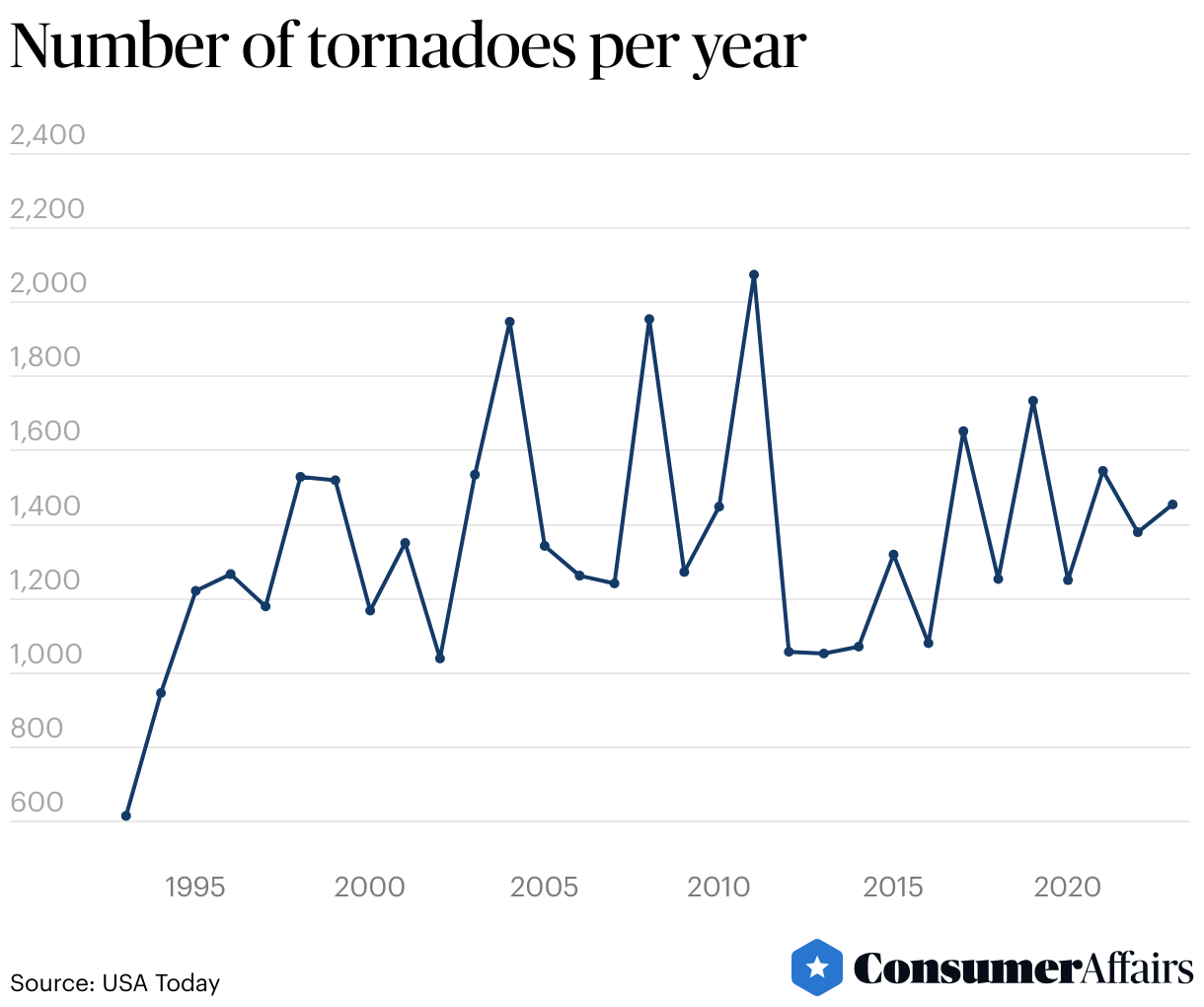
An estimated 1,000 tornadoes occur throughout the U.S. each year.
Jump to insightTornadoes caused over $1.8 billion in property damage throughout the U.S. in 2025 and have caused nearly $77 billion in property damage since 1950.
Jump to insightTornadoes are responsible for an average of 80 deaths and 1,500 injuries per year in the U.S.
Jump to insightThe most active months for tornadoes in 2025 were March, April and May.
Jump to insightAs of 2025, in total, tornadoes have caused $1.8 billion in property damage.
Jump to insightTornado damage statistics
Throughout the U.S. in 2025, tornadoes caused more than $1.8 billion in damage. While that’s an increase from the $1.4 billion reported in 2023 and $1.7 billion in 2024, tornadoes frequently cause billions of dollars worth of damage to properties and crops throughout the U.S. Though tornadoes most frequently affect the Midwest and Southeast, tornadoes can occur anywhere. Regardless of where you live in the U.S., it’s wise to prepare accordingly.
Tornado ratings
Tornadoes are rated based on wind speed. The National Weather Service (NWS) uses the Enhanced Fujita (EF) Scale to measure a tornado’s power and potential impact. The NWS describes the EF Scale as listed below.
| Rating | Wind speed (in mph) | Typical observed damage |
|---|---|---|
| EF0 | 65 to 85 | Light damage. These wind speeds can topple shallow-rooted trees and knock over other potentially dangerous items. |
| EF1 | 86 to 110 | Moderate damage. Roofs may be severely stripped, and mobile homes may be overturned. |
| EF2 | 111 to 135 | Considerable damage. This range of wind speed can tear roofs off of even sturdy homes; mobile homes may be completely destroyed and large trees snapped or uprooted. |
| EF3 | 136 to 165 | Severe damage. EF3s can overturn trains, lift heavy cars off the ground and destroy structures with weak foundations. |
| EF4 | 166 to 200 | Devastating damage. Even well-constructed, whole-frame houses can be completely destroyed. |
| EF5 | Greater than 200 | Incredible damage. EF5 tornadoes can tear solidly-built homes off their foundations and send vehicles hurtling more than 330 feet. |
Annual tornado data
As of October 2025, there are around 1,461 verified reports of tornadoes throughout the U.S., according to the National Oceanic and Atmospheric Administration’s (NOAA) Storm Prediction Center. Tornadoes can strike at any time of the year, though certain months are more conducive to tornado formation. In 2025, the most active months for tornadoes are March, April and May. Each of those months reported 300 or more tornadoes.
While scientists are closely examining the effects of climate change on tornado formation, the results are thus far inconclusive. Tornado frequency has remained somewhat consistent. However, 2025’s 1,461 preliminary total confirmed reports of tornadoes is higher than the annual average (1,251 from 1991 to 2010).
Where and when tornadoes hit, however, appears to be shifting. January 2023, for instance, saw 128 tornadoes, which is a massive spike from the month’s 35 tornado average from the NOAA’s 1991 to 2010 data collection period. But time has shifted back to normal, as January 2025 saw 20 preliminary tornadoes, closer to the average number. Meanwhile, tornado occurrences in states like Mississippi, Arkansas, Alabama, Kentucky, Tennessee, Missouri, Illinois and Indiana continue to rise.
Tornado damage costs per year
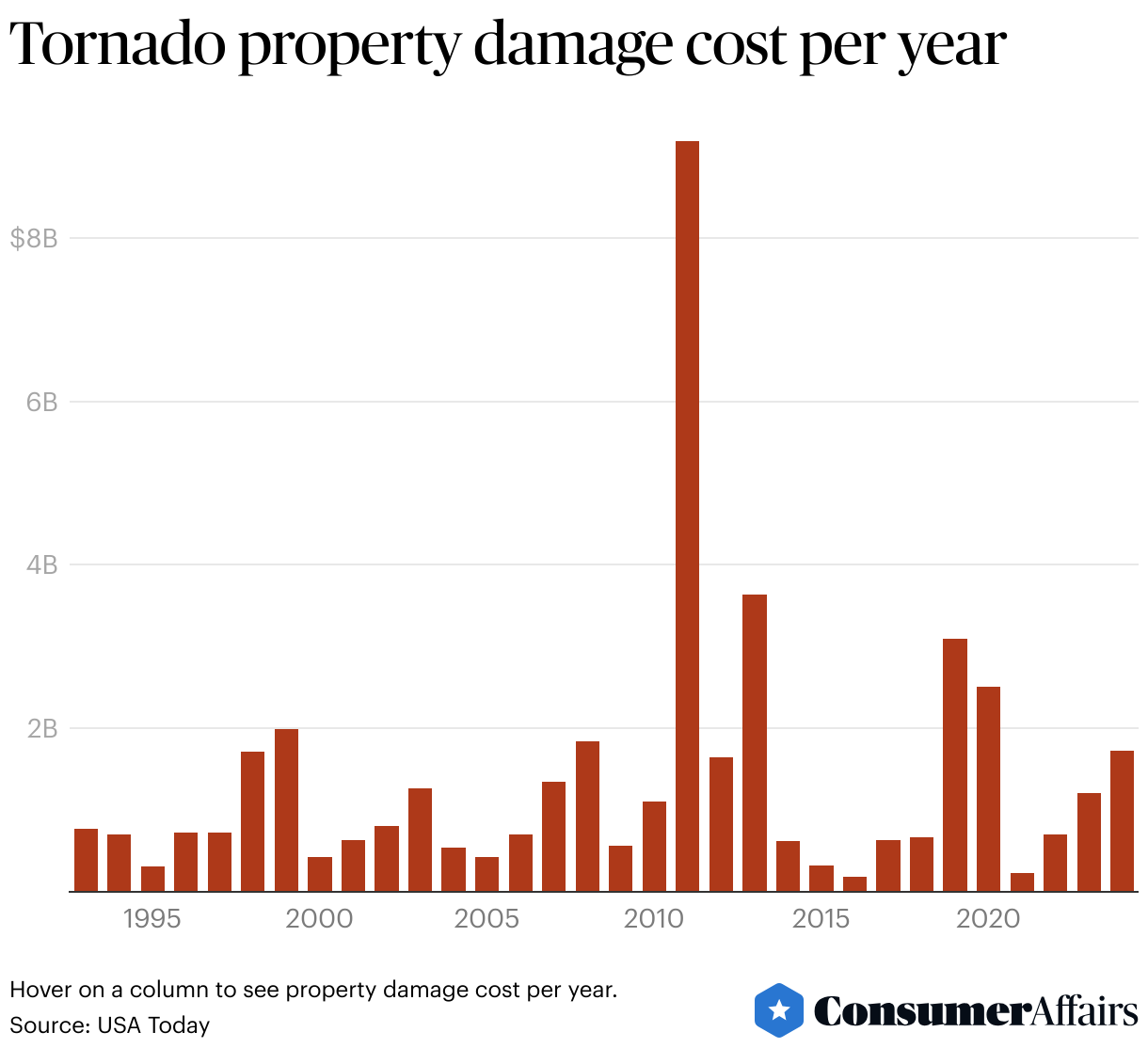
Tornadoes caused approximately $1.8 billion in damage throughout the U.S. in 2025 and more than $1.7 billion in property damage in 2024. Since 1950, when the U.S. government started officially tracking the economic impact of tornado damage, tornadoes have caused an estimated excess of $77 billion in property damage and an additional $524 million in crop damage, according to NOAA data.
Tornado damage costs vary widely by year. However, each tornado tracked in 2022 caused an estimated $684,492 in property damage. Even in years with comparatively low tornado activity, such as 2016, tornado damage costs still exceeded $181 million. Tornadoes in 2011, meanwhile, wreaked havoc across the U.S. and caused more than $9.1 billion in damages.
Tornado damage in 2024 by state
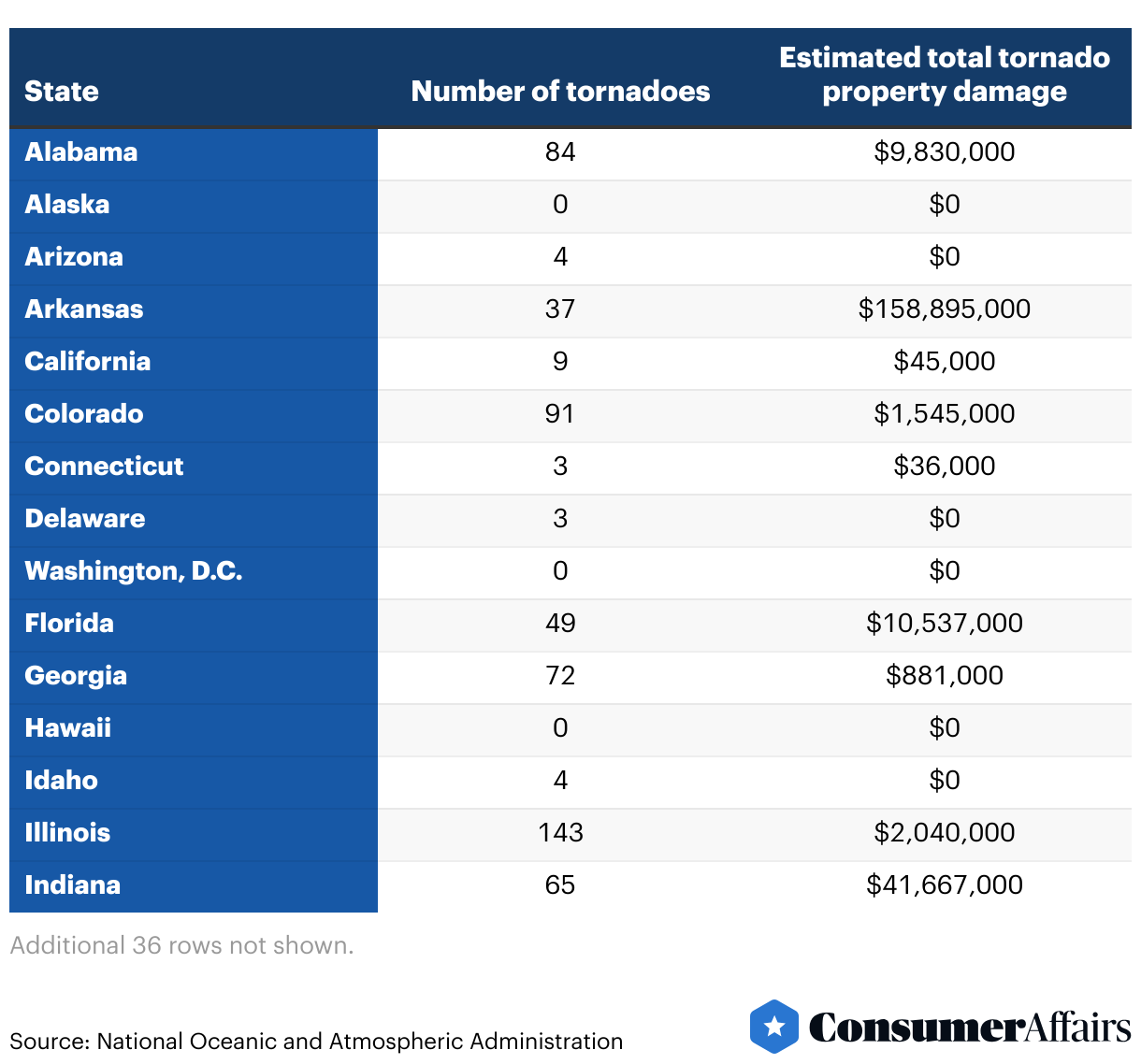
Texas experienced the most tornadoes in 2024. Its 516 twisters caused an estimated $39.5 billion in damage. Meanwhile, Florida incurred about $892.8 billion in estimated damage, 3 times more than any other state, caused by just 61 tornadoes.
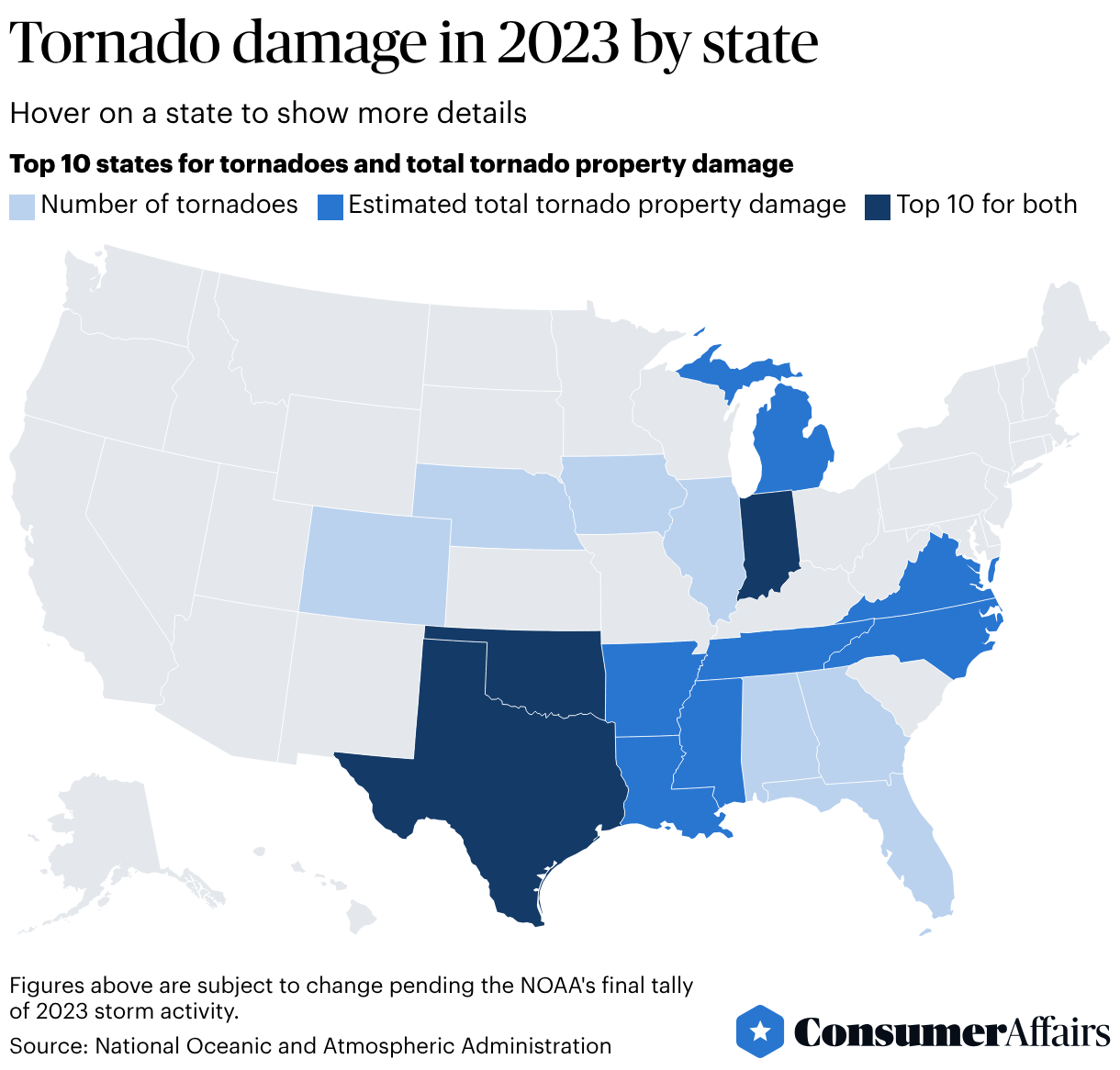
See a state-by-state breakdown below.
Tornado safety guide
Tornadoes can cause incredible devastation in a short period of time, but preparation and general storm preparedness can go a long way toward mitigating damage. That means making detailed plans before the storm comes to avoid last-minute scrambling. To prepare for tornadoes in advance, NWS guidance includes the following guidance and recommendations:
- Keep in mind that most tornado injuries and fatalities are caused by flying debris.
- Pay close attention to the possibility of severe weather, and heed local warnings.
- Establish a plan for yourself and your loved ones — including what to do and where to go, whether at home, work or school.
- Designate your “shelter.”
- Compile essential supplies, such as an NOAA weather radio, water, flashlights, batteries, extra clothes and shelf-stable foods.
- Practice your tornado safety routine to ensure you’re able to quickly put plans into motion.
- Establish a meetup point with loved ones in case of separation.
To maximize safety during a tornado, NWS recommends the following:
- If you’re in a structure with a basement, go to the basement, and take cover as best you can.
- If there is no basement, seek shelter in an interior room, such as a closet or bathroom, on the lowest floor available.
- Keep away from windows.
- Cover your head, either with a helmet or with cushions or pillows.
- If you’re in a multistory home, avoid taking shelter underneath large objects like refrigerators or chimneys.
- If you’re in a mobile home, seek shelter in a nearby sturdy building.
- Do not try to outrun a storm in a vehicle.
- If you’re caught outside and it’s too late to shelter in a building, try to get underneath a metal trash can or similar object that can offer some protection from flying debris.
Tornado safe rooms
The Federal Emergency Management Agency (FEMA) offers guidance on the design and construction of safe rooms, which are sturdy structures meant to withstand high winds from tornadoes or hurricanes. The agency provides numerous resources that offer best practices on construction essentials, such as safe room door installation and maintenance, flood hazard elevation tips and how to lay a firm foundation.
FEMA also makes Hazard Mitigation Assistance funds available for community-based safe room construction. While FEMA grants are not available for individual homeowners, states, territories and tribes can apply.
FEMA also operates a Safe Room Helpline to answer questions about safe room best practices.
FAQ
How many homes are destroyed by tornadoes each year?
While there’s no reliable data regarding this specific metric, the U.S. does track tornado property damage each year, which exceeded $1.8 billion in 2025.
How many tornadoes occur each year?
From 1991 to 2010, the U.S. experienced an average of 1,251 tornadoes per year, which is less than the 1,461 tornadoes reported through October in 2025.
What’s the best way to stay safe during a tornado?
Seek shelter quickly — preferably in a basement or other interior room — cover your head, and stay away from windows or glass.
Article sources
ConsumerAffairs writers primarily rely on government data, industry experts, and original research from other reputable publications to inform their work. Specific sources for this article include:
- USA Today, “A history of twisters: Tornadoes in the United States since 1950.” Accessed Nov. 27, 2025.
- Statista, “Economic damage caused by tornadoes in the United States from 1995 to 2024.” Accessed Nov. 27, 2025.
- National Oceanic and Atmospheric Administration, “Annual 2023 Tornadoes Report.” Accessed Nov. 27, 2025.
Figures