The best (and worst) states for renters

+1 more

Whether “competition is tight” or “the bubble is ready to burst,” conversations around housing in the U.S. often revolve around the homebuying market. However, the rental market can be just as volatile — and just as noteworthy, especially if you’re among the 28% of Americans who rent.
To identify the best states for renters, the ConsumerAffairs Research Team analyzed key metrics that measure affordability, quality of life, tenant protection laws and rental availability at the state level.
Before you start planning a move or sign any leases, read on to learn more about the benefits of renting in your state — or if you might find a better deal somewhere else.
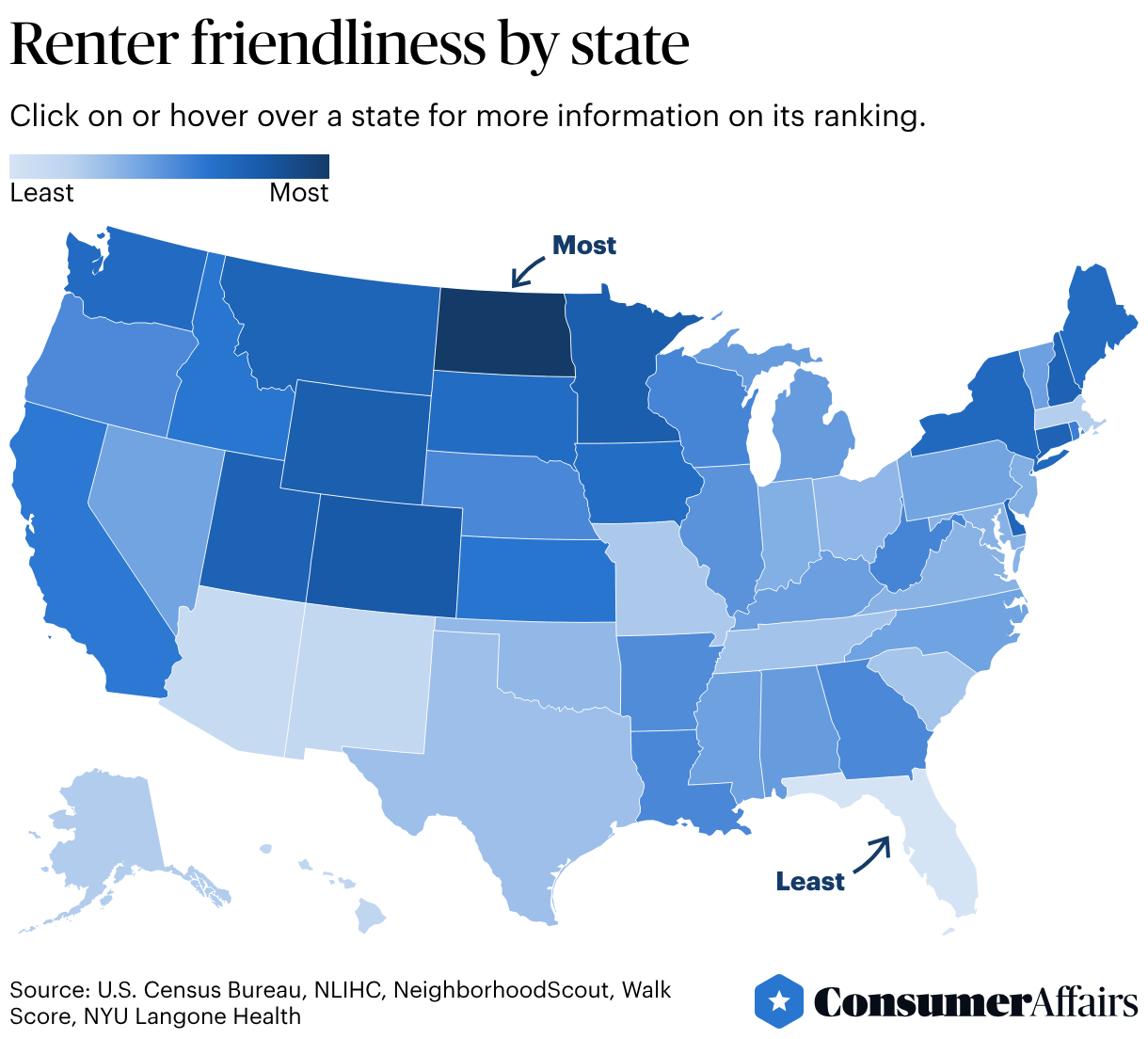
North Dakota ranks as the best state for renters for the third consecutive year, with outstanding affordability and rental availability.
Jump to insightColorado jumped in the ranks to No. 2 this year, thanks to its strong tenant protection laws.
Jump to insightFlorida ranks as the worst state for renters, largely due to poor affordability and a lack of tenant protections.
Jump to insightThe five best states for renters
So, which states offer renters the best options? The rankings surface some notable, and perhaps surprising, regional trends. The top states for tenants are clustered in the Upper Midwest (North Dakota, Minnesota) and Mountain West (Colorado, Wyoming, Utah).
But the top-ranked states are far from a monolith. Instead, they represent a range of rental environments, each offering renters unique benefits. States like top-ranked North Dakota sweep certain key categories but land in the middle of the pack for others, while third-ranked Minnesota represents a more even balance across the core areas we evaluated.
Curious how your state stacks up for renters? Check out the map below, then read on for a closer look at the states with standout stats.
1. North Dakota
Want to put down roots in a place that’s blooming with opportunity? Don’t overlook the Peace Garden State. For the third year in a row, North Dakota earned the title of the best state for renters.
North Dakota’s top rank is driven largely by the affordability of its rental market. There, the typical rent is almost a third lower than the national median. North Dakota renters are also the least cost-burdened in America, spending less than a quarter (23.7%) of their income on rent. (The typical American spends 32%.)
Renters also benefit from a rental market that offers an abundance of options: North Dakota has the highest rental vacancy rate in America. Many units are fairly new-construction, with more than two in five renter-occupied structures built after 2000, the highest rate in the nation.
Key metrics:
- Median rent: $954 (fourth lowest)
- Typical share of income spent on rent: 23.7% (lowest)
- Rental vacancy rate: 8.3% (highest)
2. Colorado
Last year, affordability challenges dragged Colorado into the bottom 10 states for renters. But in our latest analysis, Colorado shot up 42 places in the rankings to earn the second-best rank.
Unfortunately, the Centennial State still has one of the steepest median rents in the country. So, why the huge climb?
Outstanding tenant protections propelled Colorado onto the podium. It is one of just two states in the top 10 — and one of just five states in total — where state law limits how the timing, frequency or amount of rent increases. (Most states do not impose statewide rent increase limits, though some prohibit local rent control, and others allow or enforce rent caps.)
Key metrics:
- Median rent: $1,761
- Typical share of income spent on rent: 33.3%
- Rental vacancy rate: 5.1%
3. Minnesota
Minnesota is known for its amiable residents, but that’s far from the only “nice” thing the state has to offer. If you’re looking for a more renter-friendly environment, chart a path to the North Star State, ranked third best for renters.
Minnesota offers renters a vibrant balance of affordability, tenant protections and quality of life. Typical rent in the state is about 9% below the national median, and rent is climbing more slowly than nationally (3.6% year over year). The state also stands out for its park access, with 86.2% of Minnesotans living within a 10-minute walk of a park or green space.
In contrast to Colorado’s dynamic year-over-year rank changes, Minnesota is a consistently strong performer. The state has ranked in the top 10 states for renters in the past three years of our analysis, inching upward from eighth best to fourth to its current peak of third.
Key metrics:
- Median rent: $1,280
- Typical share of income spent on rent: 30.1%
- Rental vacancy rate: 5.3%
4. Wyoming
Looking for a new (rental) home on the range? Saddle up to Wyoming — the Cowboy State is the fourth best for renters. Of all the states we compared, Wyoming offers residents the strongest combination of affordability and quality of life. It’s the only state to rank in the top 10 in both of these categories.
The state ranks seventh best for quality of life, landing in the top five states for green space access and in the top 10 states for safety. But Wyoming’s strongest suit is affordability, ranking third best in the U.S. for that category. The median rent is low (under $1,000) and climbing slowly, with only a 2.5% year-over-year increase (fifth lowest).
Compared with last year’s rankings, Wyoming is the only state in this year’s top 10 to have fallen in rank year over year. However, it was only by a single position (from third to fourth).
Key metrics:
- Median rent: $992 (eighth lowest)
- Typical share of income spent on rent: 25.8% (third lowest)
- Rental vacancy rate: 6.0%
5. Utah
Rounding out the top five states for renters is Utah. Like second-ranked Colorado, Utah enters the top ranks after a significant leap from last year’s rankings (24 places).
Similar to top-ranked North Dakota, Utah stands out for its rental availability, ranking among the top 10 states for that category. Nearly four in 10 occupied rental units in the state were built since 2000, so there’s plenty of new construction that renters can choose from.
If you’re a 20- or 30-something renter interested in eventually making the leap to homeownership, note that Utah offers an accessible housing market for young adults. For example, the Provo metro area boasts the highest share of young homeowners in the U.S., with nearly a quarter of homeowners under age 35.
Key metrics:
- Median rent: $1,496
- Typical share of income spent on rent: 29.5%
- Rental vacancy rate: 5.5%
The five worst states for renters
From New England to the West, and sea to shining sea, the worst states for renters are spread across the country.
While worst-ranked states tend to be united by unaffordability and poor tenant protections, there’s significant variation in rental availability and quality of life among these worst-ranked states. Some even rank among the best in the country in certain metrics, while simultaneously taking the worst ranks in others.
Want to unpack it further? Read on for the full rundown.
1. Florida
The Sunshine State ranked third worst in last year’s analysis, but Florida is now the No. 1 worst state for renters.
A rental affordability crisis is the primary driving factor. Rent is high — about 18% above the national median — and the cost of renting is eating up 37.4% of the typical income, meaning Florida’s renters are the most cost-burdened in the nation. Rent is also rising at a faster pace than in most states.
Floridians beware: Florida also ranks last for tenant protections, with no state laws to protect renters in the four areas we evaluated. (See our full methodology for more details.)
Notably, rental availability is one factor that isn’t contributing to Florida’s bottom rank. The state has the sixth-highest rental vacancy rate.
Key metrics:
- Median rent: $1,669 (eighth highest)
- Typical share of income spent on rent: 37.4% (highest)
- Rental vacancy rate: 7.6% (sixth highest)
2. Arizona
The Grand Canyon State is certainly worth a visit, but some renters might not feel that it’s worth it to live there. Arizona ranks second worst for renters overall, including eighth worst for affordability.
The affordability ranking doesn’t reflect a current rent crisis so much as a storm brewing on the horizon. In Arizona, median rent is only about 9% above the national median. The state is also basically at the national median for the share of income that residents put toward their rent. But if rent continues to increase as it has, that could change: Arizona recently saw the sharpest rent increase in the nation — 7.8% year over year.
Livability is also a struggle; Arizona ranks sixth worst for quality of life, with particularly low scores for walkability, park access and restaurant density.
Key metrics:
- Median rent: $1,543
- Typical share of income spent on rent: 32.1%
- Rental vacancy rate: 5.8%
3. New Mexico
Among the worst states for renters, New Mexico presents a unique combination of factors. Affordability is actually a bright spot. While New Mexico renters spend more than the recommended maximum of 30% of their income on rent, the median rent is about 25% less than the national median rent.
But when it comes to quality of life, the Land of Enchantment ranks dead last. The state suffers from high crime rates, middling walkability and mediocre park and green space access.
Key metrics:
- Median rent: $1,067
- Typical share of income spent on rent: 31.6%
- Rental vacancy rate: 5.9%
4. Hawaii
Hawaii ranks fourth worst for renters, largely due to its lack of affordability. The median monthly rent is $1,971, nearly 40% more than the national median ($1,413). (Fortunately, rent has only inched up by 1.7% year over year — the smallest margin in the country.)
While the median household income in the Aloha State is the highest in the country, the typical renter doesn’t earn enough to keep up. Hawaii renters are among the most cost-burdened in the nation, spending nearly a third of their income on rent each month.
As in Florida, perhaps these high costs are contributing to an outsize share of available rental units. The rental vacancy rate in Hawaii is one of the highest in America — nearly two points higher than the national average.
Key metrics:
- Median rent: $1,971 (second highest)
- Typical share of income spent on rent: 33.1% (10th highest)
- Rental vacancy rate: 7.4% (seventh highest)
5. Massachusetts
Though Massachusetts scores in the top five states for its quality of life, renters pay a premium for the privilege. The state ranks fifth worst overall, but third worst when it comes to affordability. The median rent is 25% higher than the national median, and renters are the third-most cost-burdened in the U.S., spending nearly 35% of their monthly income on housing.
Unlike in some of the other worst-ranked states, residents of the Bay State don’t get any reprieve in the form of an abundant rental market. Rental availability remains tight, with just 3.5% of units vacant.
Key metrics:
- Median rent: $1,762 (third highest)
- Typical share of income spent on rent: 34.7% (third highest)
- Rental vacancy rate: 3.5% (third lowest)
How each state compares in renter friendliness
Are your state’s costs, laws and lifestyle friendly to renters? Or is the state you call home more hostile than hospitable for tenants?
The West is the most represented region at the top of the rankings, supplying four of the top 10 states. While no single region dominates the bottom of the rankings, it’s interesting to note that Southern states tend to score lower overall — 11 of the 16 Southern states land in the bottom half of the rankings.
Check out the table below for a full analysis of the most (and least) renter-friendly states on the map. Then, refresh your perspective with our latest expert advice on how to get the most out of renting
You may notice some major fluctuations in rankings year over year, such as Colorado skyrocketing more than 40 places or California climbing by 33. In our latest analysis, we took a more comprehensive approach to evaluating tenant protections. Those states with the most robust tenant protection laws earned higher scores in that category and were rewarded in the rankings.

Expert advice for renters
Depending on your age, lifestyle and financial situation, renting may feel like a short-term stepping stone or a long-term limbo. Even drama-free tenancy presents opportunities to protect and advocate for yourself in the present and proactively take steps toward your future goals.
Whether you’re on the winding path to homeownership or truly content to rent, check out these tips to make the most of your experience as a renter.
1. Read the lease closely (especially the fine print)
A lease agreement is legally binding, so it’s important to read the contract over thoroughly. Taking the extra time upfront to understand the terms lessens the chances of extra costs or issues during your time as a tenant and when you move out.
2. Invest in renters insurance
“(Renters insurance policies) are incredibly affordable and ensure your personal belongings are protected from theft or damage,” said Nathan Miller, founder of Rentec Direct, a property management software company.
“A landlord's insurance will only cover the building itself, so this small monthly expense is the most cost-effective way to safeguard your financial stability,” he said.
3. Focus on flexibility and controlling costs
To get the most out of renting, consider all of the variables in the equation — not just the number of beds and baths.
“A longer lease may lock in a lower rate, while a shorter one gives you room to move if your situation changes,” said Florin Petrut, a researcher for RentCafe, an apartment listings site.
Critically evaluate all the features of your property, too. “If your building offers amenities you don’t use, you may be paying for things that don’t actually improve your day-to-day life,” he said.
4. Trust your gut
Pay close attention to your initial interactions with a potentially new landlord or property manager — it can tell you a lot about the kind of rental experience you'll have.
“A landlord who skips the background or credit check might be a signal of a hands-off approach to property management, making them far more likely to neglect things like property maintenance and tenant quality,” said Miller.
On the other hand, “(a) professional, thorough process is usually a reliable indicator of a present, responsible and proactive landlord who plays by the rules,” he said.
5. Use renting as an opportunity to save
“The most important thing a renter can do — and the one most people put off — is treat the rental period as an active savings window, not a waiting room,” said Michael G. Branson, the CEO of All Reverse Mortgage, a reverse mortgage lender.
“Every month you're renting, the question should be: What would my mortgage payment be on a comparable property, and what's the difference between that and what I'm paying now?” Branson said.
How to deal with a difficult rental situation
For renters already in a difficult situation, such as dealing with unlawful entry, habitability issues or improper deductions, many experts advise starting with your state's tenant rights organization. Agencies and organizations like the Department of Housing and Urban Development, the National Low Income Housing Coalition and the National Housing Law Project offer extensive resources on tenant rights and protections in each state, as well as options for rental assistance and finding affordable housing.
However, Eric Dunn, director of litigation at the National Housing Law Project, advised that renters must be especially vigilant to protect themselves from harmful and abusive landlords, citing recent efforts to dismantle the Consumer Financial Protection Bureau and anti-consumer rulings by federal courts as evidence that hard-fought gains in tenant protections are under attack.
“Don’t assume that, one, there’s some kind of protection on the books, and, two, that it’s going to be honored and that you’re going to be able to enforce violations,” Dunn warned.
That said, it’s still always a good idea to document the condition of the unit and all your interactions with your landlord or property management company, especially regarding maintenance and repairs. “A text or email trail (can be) the difference between a winnable dispute and a he-said-she-said,” said Branson.
Methodology
The ConsumerAffairs Research Team ranked all 50 states to determine the best places for renters using a scoring system based on four categories, each made up of individually weighted metrics.
Each state received a score for every metric, with the top-performing state earning the maximum number of points, and others scored relative to that state. We summed the individual scores to calculate category totals, then combined category scores for a final score out of 100 points.
- Affordability (30 points): This category includes median rent (13 points), the typical percentage of income spent on rent, calculated by dividing the median rent by the median monthly income (13 points) and the percentage increase in median rent between 2023 and 2024 (4 points). Data is from the U.S. Census Bureau (2024).
- Quality of life (30 points): This category includes violent and property crime rates per 1,000 people (8 points each), average Walk Score (6 points), the average percentage of residents living within a 10-minute walk of a green space (5 points) and the number of restaurants per 100,000 people (3 points). Data is from NeighborhoodScout (2024), Walk Score (2026), NYU Langone Health (2024) and the U.S. Census Bureau (2023).
- Tenant protections (25 points): This category evaluates whether a state has key laws in place to protect renters. Data is from the National Low Income Housing Coalition (2026). Specifically, we assessed whether the state:
- Requires landlords to provide “just cause” to terminate a tenancy or refuse lease renewal (7 points)
- Increases enforcement of housing codes to ensure safe and quality housing (7 points)
- Limits how a landlord can handle rent increases (6 points)
- Limits the amount landlords can charge in tenant fees (such as application or late fees) (5 points)
- Rental availability (15 points): This category includes the percentage of renter-occupied structures built after 2000 (7.5 points) and the rental vacancy rate (7.5 points). Data is from the U.S. Census Bureau (2024).
Reference policy
We love it when people share our findings! If you do, please link back to our original article to credit our research.
Questions?
For questions about the data or if you'd like to set up an interview, please contact jrodriguez@consumeraffairs.com.
Article sources
ConsumerAffairs writers primarily rely on government data, industry experts and original research from other reputable publications to inform their work. Specific sources for this article include:
- U.S. Census Bureau, “Explore Census Data.” Accessed March 30, 2026.
- NeighborhoodScout, “NeighborhoodScout.” Accessed March 30, 2026.
- Walk Score, “Walk Score.” Accessed March 30, 2026.
- NYU Langone Health, “City Health Dashboard.” Accessed March 30, 2026.
- National Low Income Housing Coalition, “State and Local Tenant Protections Database.” Accessed March 30, 2026.
- Board of Governors of the Federal Reserve System, “Report on the Economic Well-Being of U.S. Households in 2024 - May 2025.” Accessed March 30, 2026.
Figures