Long-Term Care Statistics (2026)

+2 more



There are about 66,630 regulated long-term care facilities in the U.S., according to the National Center for Health Statistics. Together, these institutions, which include adult day care centers serve about 6.9 million individuals.
Over the next 10 years, the number of residents in each of these facilities is expected to grow sharply. If trends hold up, the number of nursing home residents could increase by over 75% to 2.3 million residents by 2030.
This has the potential to not only put a strain on the existing network of long-term care facilities but also contribute to the ballooning cost of health care for individuals ages 65 and over.
Key insights
Over half (56%) of Americans turning 65 today will develop a disability serious enough to require long-term service and support.
Jump to insightSeniors who require long-term care will need an average of $138,000 worth of long-term support services.
Jump to insightThe least expensive state for nursing home care in a semiprivate room is currently Texas at $5,600 monthly, and Missouri has the cheapest average for a private room at $6,481 per month. On the other hand, Alaska’s nursing home costs are an outlier at $34,434 a month for a semiprivate or private room.
Jump to insightIn 2022, long-term care insurance paid out more than $1.5 million total in claims to 45,361 individuals.
Jump to insightTypes of long-term care
There are long-term care options for individuals depending on the needed level of support.
- Adult day services centers: These centers provide professional programs designed for individuals to receive supervised care in a group setting with structured activities. Some centers provide personal care, transportation, medication management and meals.
- Home health: Home health aides provide professional services for individuals who need personal care attention in one’s home to assist with an illness or injury.
- Residential care communities: Also known as assisted living communities, these facilities provide a supported environment for individuals who are no longer able to live safely on their own, providing personal care and health services.
- Nursing homes: These facilities provide more medical care and supervision than residential care communities. Nursing homes provide personal care assistance, medication, therapies and rehabilitation, and on-site nursing care 24 hours a day.
- Hospice centers: These centers specialize in providing medical care, pain management and emotional support to individuals in the final stages of an incurable illness and their families.
Across these five major long-term facility types, 6.9 million individuals used these services in 2020. Three million individuals utilized home health care, representing 43.8% of the total number of individuals participating in long-term health care services. Individuals residing at nursing homes and residential care communities totaled 2.1 million, 30.9% of the total number of individuals utilizing long-term care facilities in 2020.

Why is demand for long-term care increasing?
There are three main factors causing an increase in demand for long-term care: population shifts, increasing life expectancies and the increased risk of injuries and disabilities that these create.
Population shifts
Baby boomers, whose births sparked massive population shifts between 1946 and 1964, began turning 65 in 2011, and they currently make up about 20% of the population. Twenty years ago, when the Silent Generation was in a similar age range (56 to 73), they only made up about 15% of the population.
The last boomers will turn 65 in 2029, and because they represent a larger percentage of the population than previous aging generations, the long-term care industry will face new challenges and growth over the next decade.
Increased life expectancies
Life expectancy is currently estimated to be 77.5 years, according to the National Center for Health Statistics. Baby boomers also have higher life expectancies than previous generations. For 65-year-olds, life expectancies increased from 11.9 years in 1902 to 18.9 years in 2022, according to recent data.
A greater number of caregiving facilities may be necessary to accommodate the growing number of people who are living longer.
Increased risk
As people age, they are also at greater risk of injuries and disabilities that may necessitate care. Disabilities affect 2 in 5 adults age 65 and over, according to the Centers for Disease Control and Prevention (CDC).
The U.S. Department of Health and Human Services (HHS) estimates that over half (56%) of Americans turning 65 today will develop a disability serious enough to require long-term service and support. The HHS estimates that from 2020 to 2065, the number of individuals with significant disabilities is expected to grow from 7.6 million to 14.7 million given the aging population — in percentage terms, the share of the aged population with disabilities increases from 14% to 16%.
The cost of long-term care
A 2022 study from the HHS found that seniors who require long-term care will need $138,000 worth of long-term support services, on average. While insurance and public programs will cover some of these costs, the study estimated that families will pay for 37% of the costs themselves, with approximately 14% of seniors paying over $100,000 out of pocket on long-term care expenses.
Currently, the median national monthly cost for nursing home care is $8,641 for a semiprivate room and $9,872 for private care, and costs may go up significantly in the coming decades.
Median nationwide cost of nursing home care
| Year | Semiprivate room | Private room |
|---|---|---|
| 2024 | $8,641 per month | $9,872 per month |
| 2030 (estimate) | $10,318 per month | $11,787 per month |
| 2040 (estimate) | $13,867 per month | $15,841 per month |
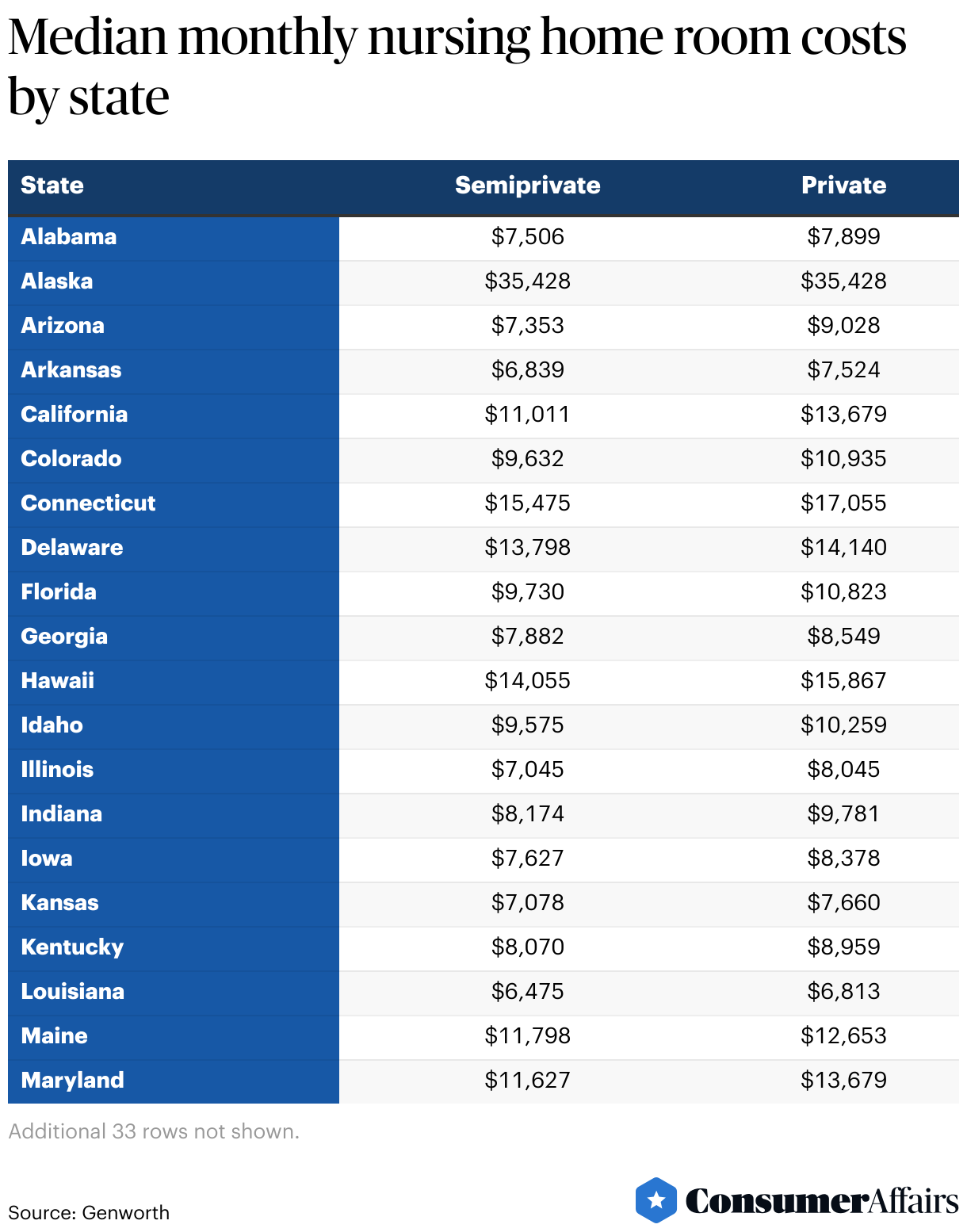
Nursing home costs do vary by state, though. According to Genworth’s 2021 Cost of Care Survey and estimating for inflation, the least expensive state for nursing home care in a semiprivate room is currently Texas at $5,600 monthly, and Missouri has the cheapest average for a private room at $6,481 per month. On the other hand, Alaska’s nursing home costs are an outlier at $34,434 a month for a semiprivate or private room.
Women spend 3.6 years in long-term care, on average, while men spend an average of 2.5 years.
Alaska’s exorbitant costs are related to population distribution. More rural areas may face staffing shortages. Heat and electricity can also be expensive in certain regions. Alaska also has one of the fastest aging populations in the country, with the 60-plus demographic increasing by 68% from 2010 to 2022 — putting approximately 20% of Alaskans at age 60 and older. The amount of care available is low because there hasn’t been great demand historically. The growing aging population and its limited nursing home availability could make costs skyrocket even higher in subsequent decades.
Other expensive areas for nursing home care include New York, Hawaii and Connecticut, while Oklahoma and Missouri offer some of the lowest monthly costs.
According to Genworth, other long-term care options are generally more affordable, but they may not suit residents with more extensive care needs.
- Home health aides currently cost $5,625 per month on average. Genworth estimates this rate may increase to $6,717 per month by 2030.
- Adult daycare currently costs $1,847 per month on average. Genworth estimates this rate may increase to $2,205 per month by 2030.
- Assisted living currently costs $4,917 per month on average. Genworth estimates this rate may increase to $5,871 per month by 2030.
COVID-19 amplified the supply and demand gap for long-term home-based care. According to a study by the Economic Policy Institute, employment in the long-term care industry including nursing homes and residential care facilities had been increasing prior to the COVID pandemic but was still failing to meet the industry demands. The industry saw substantial job loss during the pandemic, and employment remains almost 400,000 below its pre-pandemic threshold. Compounding this shortage, the median hourly wage for individuals in the long-term care industry is $15.22 compared to $20.07 for employees in the overall workforce.
According to the COVID Tracking Project, deaths in long-term care residences contributed to over one-third of all U.S. COVID-19 deaths. The effects of COVID-19 on long-term care facilities may further promote aging in place with in-home help among seniors, a trend that was already popular. A study from the Associated Press-NORC Center for Public Affairs Research post-pandemic found that 88% of Americans prefer to receive any ongoing assistance in their own homes or the homes of a loved one. Additionally, only 12% would opt to receive care in a senior community or nursing home.
However, the cost of long-term care really depends on how much care a person needs. According to the HHS, 56% of adults 65 and older will require some long-term services support, with an average projected duration of 3.1 years. Of the people that will need long-term care, about 20% are expected to require less than two years of care, 15% need at least two but less than five years and 22% require five or more years of care.
Nursing home costs by length of stay
| Percentage of individuals ages 65 and older | Amount of care needed | Median total cost |
|---|---|---|
| 43.6% | None | $0 |
| 11.9% | Less than 1 year | Under $103,692 |
| 7.9% | 1 to <2 years | $103,692 to $207,384 |
| 14.7% | 2 to <5 years | $207,384 to $517,423 |
| 22.1% | 5 years or more | $518,460+ |
Long-term care insurance statistics
Currently, Medicare does not cover nursing home stays longer than 100 days, but most nursing homes will accept Medicaid payment if the resident qualifies. If an older person doesn’t qualify for Medicaid, they’ll likely have to arrange for another source of funding, like long-term care insurance.
Long-term care insurance helps a large number of people, according to the 2023 Milliman Long Term Care Insurance Survey. In 2022, long-term care insurance paid out more than $1.5 million total in claims to 45,361 individuals.
The average individual claim covers $54,019 in long-term care costs, but averages vary at different types of long-term care facilities.
- For nursing homes, the average individual claim size is $50,859.
- For assisted living facilities, the average individual claim size is $71,328.
- For home-based care, the average individual claim is $40,636.
As people get older, they’re more likely to put long-term care insurance to use. According to AARP, individuals over the age of 70 file 95% of long-term care insurance claims, and nearly 70% of total claims are filed by people older than 81.
According to AARP, initial premiums for a consumer who is 65 could be 8% to 10% higher than those of someone aged 64.
Nursing home statistics 2024
According to a 2010 study, mental disorders represent about 48% of all nursing home admissions, while physical (somatic) disorders comprise 43%, and social/emotional problems make up the remaining 8%.
Among somatic disorders in nursing homes, the most common are circulatory system diseases (like strokes or heart failure), nervous system diseases (like Parkinson’s disease) and musculoskeletal diseases (like osteoarthritis). Complications from diabetes, including cardiovascular disease, nerve damage and kidney damage, are also contributing to a growing number of nursing home admissions.
By age, 60.1% of individuals living in nursing homes are ages 75 and over, with the largest percentage of individuals 85 and older, 32.8%.

Memory care statistics
As mentioned above, nearly half of nursing home residents have cognitive impairments like dementia, and according to a report from the Alzheimer’s Association, 58% of patients who stay 100 days or longer in a nursing home have memory diseases.
Cognitive patients in nursing homes may have more advanced diseases than those in memory care and other treatment facilities. While memory-targeted assisted living residences may offer therapies and activities meant to stimulate cognitive activity, nursing home care is typically targeted to patients who need greater medical attention or are nearing the end of their lives.
However, memory-focused care can also be found in other long-term care facilities.
- Home health care: 36% of home health care recipients are Alzheimer’s patients.
- Adult day care: 28% of patients receiving adult day services have Alzheimer’s or other dementia, and 10% of adult day care centers specialize in memory care.
- Residential care: 34% of residential care facility residents have memory impairments, and 58% of these facilities offer programs for residents with Alzheimer’s disease or other dementias. Additionally, 19% have dedicated memory care wings which offer increased attention versus traditional assisted living facilities.
With the growing number of people ages 65 and older, the percentage of people with cognitive impairments is expected to grow. Currently, approximately 6.7 million seniors have Alzheimer’s disease. By 2050, the number of new yearly cases of Alzheimer’s and other dementias is expected to double. When coupled with the rising cost of long-term care, this could increase the burden on unpaid caregivers to take care of loved ones who otherwise may not be able to afford care.
Currently, over 11 million people provide unpaid care to Alzheimer’s patients and those with other dementias, spending an estimated 18 billion hours helping in 2022. Most of these caregivers are family members or loved ones, spending an average of 30 hours per week taking care of the patient.
Hospice care statistics
Hospice care is a comfort-focused level of care for terminal patients. About 24% of hospice patients have a principal diagnosis of cancer, 24% have dementia or nervous system disorders and roughly 21% have circulatory issues. Heart failure, respiratory disease and other digestive diseases are also common ailments for hospice patients.
Hospice caregivers regularly visit patients at their residences. According to a 2023 report by the National Hospice and Palliative Care Organization (NHPCO), the average length of stay by location was 95 care days at private residences, 165 care days at assisted living residences and 109 care days at nursing homes.
If a physician has provided the patient with a prognosis of under six months to live, Medicare will automatically cover hospice. In 2021, hospice served over 1.7 million Medicare beneficiaries, averaging 92.1 days of care per person.
Article sources
ConsumerAffairs writers primarily rely on government data, industry experts, and original research from other reputable publications to inform their work. Specific sources for this article include:
- National Center for Health Statistics, “National Post-acute and Long-term Care Study.” Accessed Jan. 27, 2024.
- U.S. Census Bureau, “An Aging World: 2015.” Accessed Jan. 28, 2021.
- Centers for Disease Control and Prevention (CDC), “CDC: 1 in 4 US adults live with a disability.” Accessed May 25, 2021.
- Office of the Assistant Secretary for Planning and Evaluation, “Long-Term Services and Supports for Older Americans: Risks and Financing Research Brief, 2022.” Accessed Jan. 28, 2024.
- Genworth, “Cost of Care Survey.” Accessed Jan. 28, 2024.
- Anchorage Daily News, “Alaska nursing homes extraordinarily expensive for seniors.” Accessed May 26, 2021.
- COVID Tracking Project, “Long-Term-Care COVID Tracker.” Accessed May 25, 2021.
- The Associated Press-NORC Center for Public Affairs Research AARP, ”Long Term Care in America: Americans Want to Age at Home.” Accessed Jan. 28, 2024.
- Medicare, “Skilled nursing facility (SNF) care.” Accessed May 25, 2021.
- American Association for Long-Term Care Insurance, “Long-Term Care Insurance Facts - Data - Statistics - 2019 Report.” Accessed Jan. 28, 2024.
- Broker World, “2023 Milliman Long Term Care Insurance Survey.” Accessed Jan. 28, 2024.
- BMC Geriatrics, “Medical Conditions of Nursing Home Admissions.” Accessed Jan. 28, 2024.
- Alzheimer’s Association, “2023 Alzheimer’s Disease Facts and Figures.” Accessed Jan. 28, 2024.
- National Hospice Care and Palliative Care Organization (NHPCO), “NHPCO Facts and Figures 2023 Edition.” Accessed Jan. 28, 2024.
- Health.Alaska.gov, “Alaska Commission on Aging (ACOA) Senior Snapshot Older Alaskans in 2022.” Accessed Jan. 27, 2024.
- Centers for Disease Control and Prevention (CDC), “Life Expectancy in the U.S. Dropped for the Second Year in a Row.” Accessed Jan. 28, 2024.
- AARP, “5 Things You Should Know About Long-Term Care Insurance.” Accessed Jan. 28, 2024.
- Economic Policy Institute, “The State of the Residential Long-Term Care Industry.” Accessed Jan. 28, 2024.
- Population Reference Bureau, “Population Bulletin, Vol. 70, No. 2.” Accessed Jan. 31, 2024.
- U.S. Census Bureau, “Age and Sex Tables.” Accessed Jan. 31, 2024.
- AARP, “Buy Long-Term Care Insurance at the Right Age to Get the Best Value.” Accessed Jan. 31, 2024.
Figures