These are the safest states in America

+1 more


Concerns about crime are rising across the U.S., with a growing share of Americans calling for action. Polling from the Pew Research Center shows that 58% of adults believe reducing crime should be a top priority for the president and Congress, up from 47% when President Joe Biden first took office. Since crime is so top of mind for many Americans, it’s no surprise that safety is increasingly influencing decisions around moving.
Whether you're planning a local move or relocating across state lines, finding a community with lower crime rates should be a top consideration.
To help individuals and families make informed choices, ConsumerAffairs analyzed and ranked all 50 U.S. states and Washington, D.C., across five key categories: violent crime, property crime, driving safety, public safety and climate safety. These rankings identify the safest states in the U.S. for 2024.
New Hampshire is the safest state in the U.S. It has the lowest property crime rate, including the lowest number of burglaries per 100,000 people. It also has one of the lowest violent crime rates in the U.S.
Jump to insightThe top six safest states are in the Northeast, and eight of the top 10 are in the region. Idaho and Wyoming are the only states in the top 10 not in the Northeast. Idaho (seventh), West Virginia (11th) and Iowa (13th) are the safest states in the West, South and Midwest, respectively.
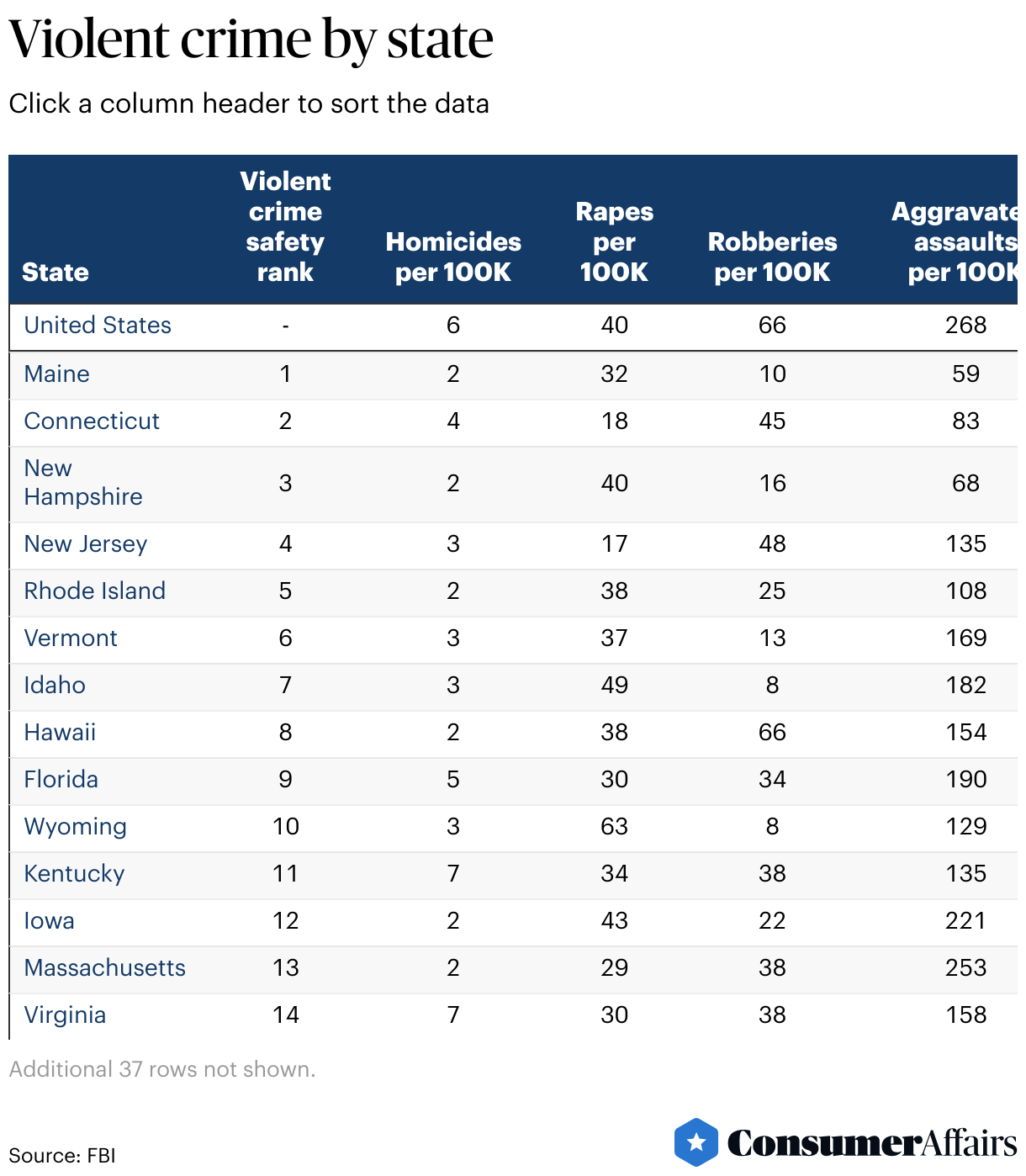
Jump to insightMaine has the lowest overall rate of violent crime, and New Hampshire has the lowest overall rate of property crime.
Jump to insightThe least safe state is New Mexico. It scored poorly for violent crime, property crime and driving safety. It has the highest rates of aggravated assaults, burglaries and road rage incidents with gun violence of all states.
Jump to insight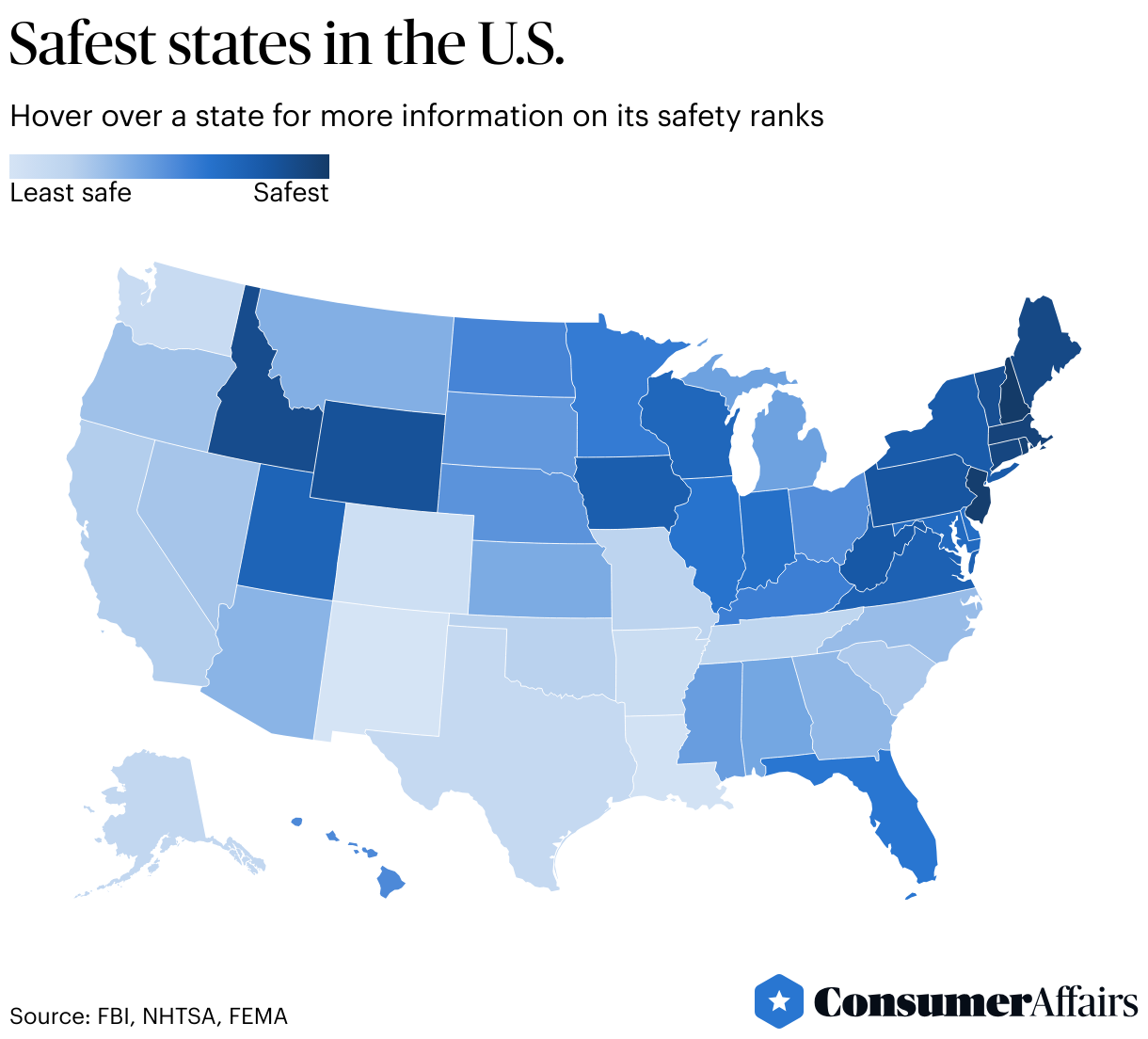
Top 10 safest states
ConsumerAffairs weighed five factors to determine the safest states in 2024: violent crime, property crime, driving safety, public safety and climate safety. Here’s what the categories covered:
- Violent crime (40 points): Rates of four types of violent crime per 100,000 people (homicide, rape, robbery and aggravated assault), each worth 10 points
- Property crime (30 points): Rates of three types of property crime per 100,000 people (burglary, larceny-theft and motor vehicle theft), each worth 10 points
- Driving safety (10 points): The number of fatalities involving aggressive driving or careless driving per 100,000 people and road rage incidents with gun violence per 100,000 people, each worth five points
- Public safety (10 points): The number of law enforcement officers per 100,000 people
- Climate safety (10 points): The number of climate disasters over the past 10 years
The best-performing state for each of the 11 individual metrics received the maximum number of points, and all other states were assigned points relative to how they compared with the best-performing state. Scores were added together to calculate a final overall safety score, with a maximum score of 100 points. Below, we highlight the 10 safest states.
1. New Hampshire
Safety score: 87.2
New Hampshire is currently the safest state in the U.S., moving up from its No. 2 ranking last year. This year, it ranked at the top across several metrics for both violent crime and property crime categories. The state has the nation’s lowest burglary rates, with just 73.5 per 100,000 residents. It also has the third-lowest homicide rate, at 1.8 per 100,000 residents, and the second-lowest rate of aggravated assault.
Although New Hampshire falls in the middle of the pack when it comes to the number of law enforcement officers, it ranks third in driving safety. These factors combined make New Hampshire an exceptionally safe place to live.
2. New Jersey
Safety score: 86.2
New Jersey ranks as the second-safest state in the U.S. this year, dropping from its top-ranked position last year. Despite the shift, it continues to rank highly in terms of violent crime rates. The state has the lowest rate of rape in the study, with just 16.8 incidents per 100,000 residents. That falls well below the national average number of 40 incidents per 100,000 residents.
New Jersey also ranks second overall for law enforcement presence, with 424 officers per 100,000 residents. However, the state could improve in driving safety; it ranks 18th overall in that category, including 30th in deaths involving aggressive or careless driving.
3. Rhode Island
Safety score: 84.7
Rhode Island is the third-safest state in the U.S., up from its seventh-place ranking last year. It stands out for its top ranking in overall driving safety, including for the lowest rate of fatalities involving aggressive or careless driving, at just 1.3 per 100,000 residents. It also has the lowest homicide rate in the study, at 1.5 per 100,000 residents, well below the national average of 6.3. Rhode Island ranks sixth overall in property crime and third in climate safety despite being a coastal state.
4. Massachusetts
Safety score: 83.4
Massachusetts maintained its fourth-place finish from last year. The state performs well across both violent crime and property crime categories. It stands out with the second-lowest larceny-theft rate, at 827.6 per 100,000 residents. That’s below the national average of 1,402 per 100,000 residents. It also has the fifth-lowest homicide rate and fourth-lowest rape rate in the country. While Massachusetts ranks 19th in robberies, its rate of 37.7 per 100,000 residents is still well below the national average of 66.1.
5. Connecticut
Safety score: 81.9
Connecticut ranks as the fifth-safest state in the U.S., up from its sixth-ranked position last year. The state excels in several safety categories — ranking second best for violent crime rate and ninth for property crimes. Connecticut has the second-lowest rate of rape in the nation, at 18.1 per 100,000 residents. It also ranks third for the lowest rate of aggravated assault, with 83.3 incidents per 100,000 residents.
6. Maine
Safety score: 81.3
Maine, which ranked third on our list last year, has the lowest overall violent crime rate and leads the nation with the lowest rate of aggravated assaults, with just 59 per 100,000 residents, compared with the national average of 268. The state also has the second-lowest burglary rate and the seventh-lowest homicide rate. It could’ve finished higher if not for lower scores in climate safety (42nd) and law enforcement presence (47th).
7. Idaho
Safety score: 81.0
Idaho has moved up a spot in this year’s rankings. The state ranks best overall in rate of larcenies and thefts, at 677.1 per 100,000 residents — over 50% below the national average. Robberies are also relatively rare in Idaho; it has the second-lowest rate in the country, at just 8.2 per 100,000 residents. The state ranks second overall for the lowest rate of property crime and seventh for the lowest rate of violent crime — all while ranking 49th in law enforcement presence.
8. Vermont
Safety score: 78.8
Vermont is the eighth-safest state in our rankings, down three spots from last year. It ranks sixth best in violent crime and 11th in property crime. It also lands in the top 10 for driving safety, with just three fatalities due to aggressive or careless driving per 100,000 residents; the national average is five per 100,000 residents. However, it has fewer law enforcement officers than most states, with just 166.8 officers per 100,000 residents — 28% below the national average of 231.4.
9. Wyoming
Safety score: 78.4
Wyoming ranks as the ninth-safest state in the U.S., up two spots from last year. It has the lowest rate of robberies in the nation, at just 7.9 per 100,000 residents. It also has a low rate of aggravated assaults and a large law enforcement presence, ranking fifth in both categories. However, the state has the 47th-highest rate of rape, at 62.8 per 100,000 residents; that’s 57% higher than the national average.
10. Pennsylvania
Safety score: 77.6
Pennsylvania ranks as the 10th-safest state in our study due to a strong performance in the property crime category and high law enforcement numbers. It ranks eighth in the U.S. for lowest rate of property crime. It has the seventh-highest number of law enforcement officers, with 269.3 per 100,000 people, well over the national average.
Which states ranked as the least safe in 2024?
The five least safe states in the U.S. are New Mexico, Louisiana, Washington, D.C., Colorado and Arkansas. (We included the capital as a state for the purposes of our study.) Each of the five ranks among the 10 worst states for violent crime, property crime and driving safety. New Mexico, the least safe state in the U.S., ranks third worst in violent crime, third worst in property crime and last in driving safety.
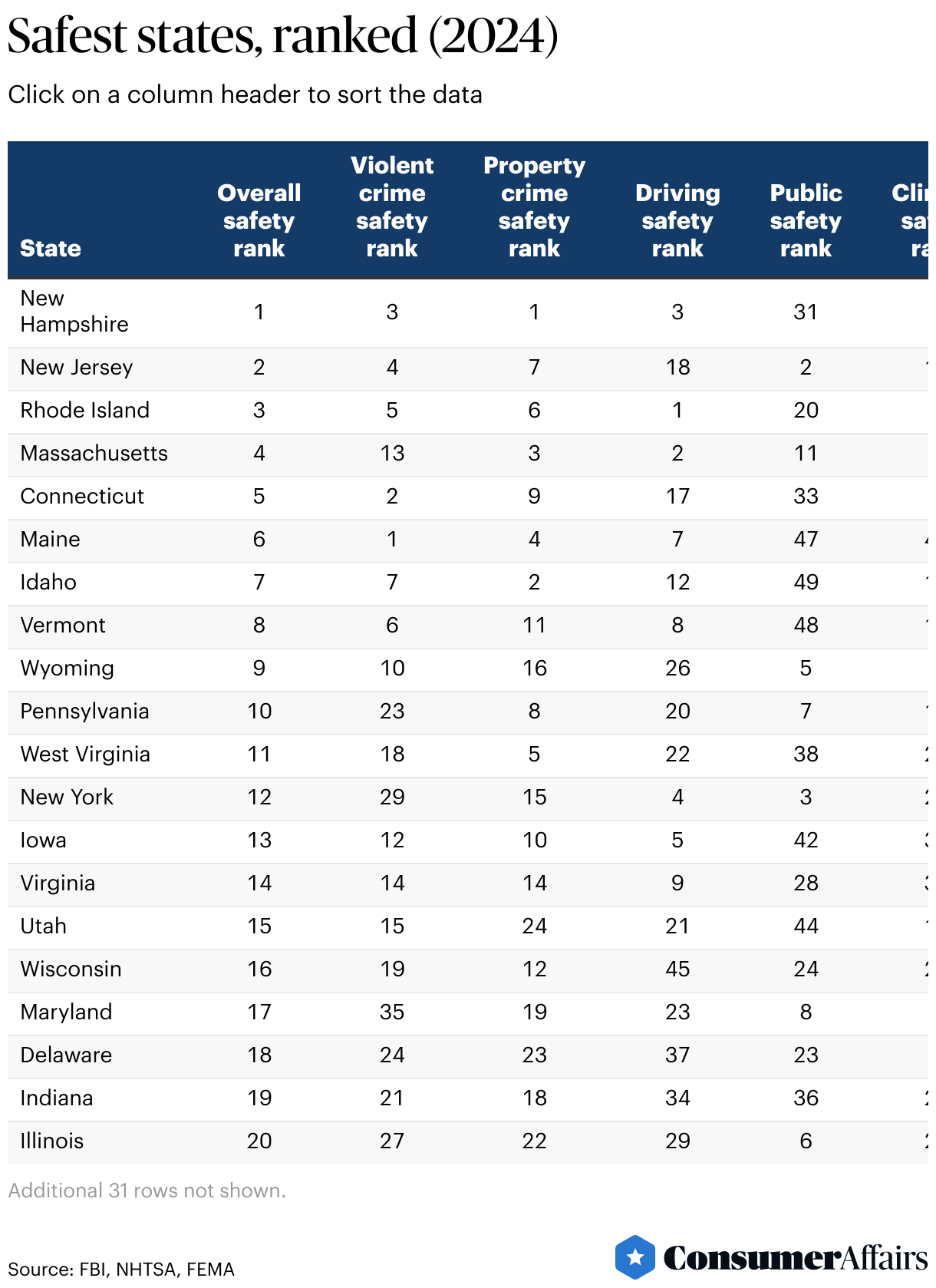
See how your state ranks
The table below shows all 50 states and Washington, D.C., ranked by overall safety score. Rankings for each of the five categories are also included. Find out how your state compares with others in the U.S.
Bottom line
Crime happens everywhere, whether you’re in New Hampshire (ranked as the safest state), New Mexico (ranked as the least safe) or anywhere in between. To reduce your risk of being the victim of a violent crime or property crime, consider installing a home security system.
If you’re planning to move to a new state, research crime statistics and trends in the states and cities you're considering. You can find this information in online reports from the FBI, state agencies and local governments.
Methodology
To determine the safest states in 2024, the ConsumerAffairs Research Team compared all 50 U.S. states and Washington, D.C., across five categories: violent crime, property crime, driving safety, public safety and climate safety. The scores for each of the five categories were calculated using the following metrics:
- Violent crime (40 points): The violent crime score is based on four metrics: homicides per 100,000 people (10 points), rapes per 100,000 residents (10 points), robberies per 100,000 people (10 points), and aggravated assaults per 100,000 people (10 points). We gathered this data from the FBI’s Crime Data Explorer. Data is from 2022.
- Property crime (30 points): The property crime score is based on three metrics: burglaries per 100,000 people (10 points), larcenies-thefts per 100,000 people (10 points), and motor vehicle thefts per 100,000 people (10 points). We gathered this data from the FBI’s Crime Data Explorer. Data is from 2022.
- Driving safety (10 points): The driving safety score is based on two metrics: total fatalities due to aggressive driving or careless driving per 100,000 people (five points) and the number of road rage incidents involving gun violence per 100,000 people (five points). We gathered data from the National Highway Traffic Safety Administration (NHTSA). Data is from 2022.
- Public safety (10 points): The public safety score is based on the number of law enforcement officers per 100,000 people. We gathered data from the FBI’s Crime Data Explorer. Data is from 2022.
- Climate safety (10 points): The climate safety score is based on the number of climate disasters over the past 10 years. We gathered data from the Federal Emergency Management Agency (FEMA).
The best-performing state for each of the 11 individual metrics received the maximum number of points, and all other states were assigned points based on how they compared relative to the best-performing state. We added the scores together to calculate an overall safety score, which has a maximum of 100.
For questions about the data or if you'd like to set up an interview, please contact acurls@consumeraffairs.com.
Reference policy
We love it when people share our findings! If you do, please link back to our original article to credit our research.
Article sources
ConsumerAffairs writers primarily rely on government data, industry experts, and original research from other reputable publications to inform their work. Specific sources for this article include:
- FBI, “Crime Data Explorer.” Accessed July 22, 2024.
- Federal Emergency Management Agency, “OpenFEMA Dataset: Disaster Declarations Summaries - v2.” Accessed July 22, 2024.
- National Highway Traffic Safety Administration, “Fatality Analysis Reporting System (FARS).” Accessed July 22, 2024.
- Pew Research Center, “What the data says about crime in the U.S.” Accessed Aug. 14, 2024.
Figures