How Many Houses Are Built Each Year in the U.S.? 2026

+2 more


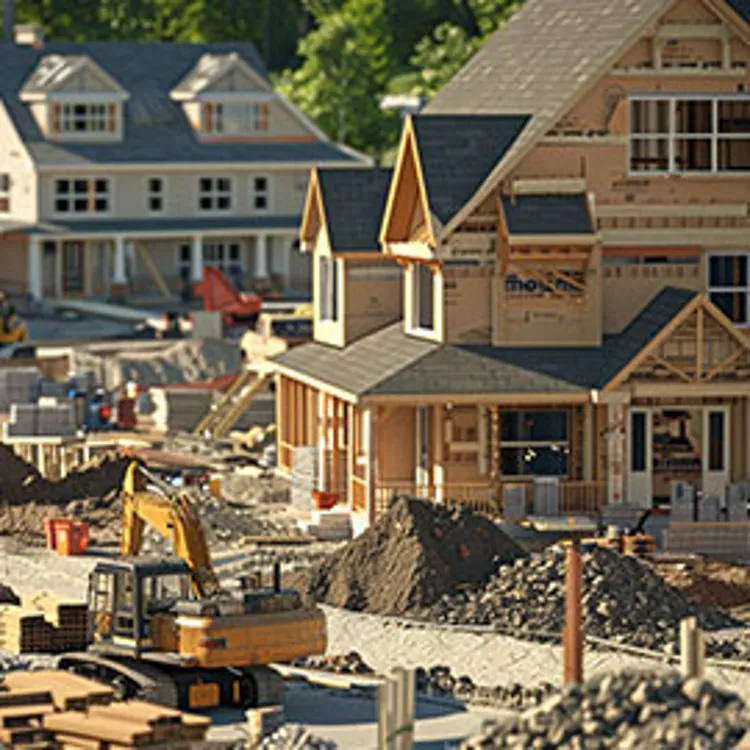
The COVID-19 pandemic wreaked havoc on the U.S. construction landscape, though homebuilding throughout the U.S. appears to be on a more stable trajectory now.
The business of building isn’t exactly booming in every state (or region). However, prices for materials and labor continue to climb. Despite a litany of ongoing economic concerns, experts foresee modest growth for U.S. residential construction within the next five years and perhaps beyond.
Continue reading for a state-by-state overview of how many homes are being built in the U.S. each year, as well as current construction costs and homebuilding price trends.
About 134,000 single‐family home authorizations were recorded in August 2025, per the U.S. Census Bureau.
Jump to insightAugust 2025 also saw an estimated 78,000 single‐family housing starts, while completions of privately owned housing clocked in at about 96,000.
Jump to insightU.S. construction spending fell to about $2,139 billion in July 2025. This was a slight drop from June 2025 and a .1% decrease from June 2024.
Jump to insightThe overall value of the U.S. construction industry in 2023 was almost $1.98 trillion, which was an increase of about 7% from its $1.85 trillion value in 2022.
Jump to insightThe number of newly completed housing units in the U.S. grew from 883,900 in 2014 to 1,626,800 in 2024, which was an increase of about 84%.
Jump to insightNew home build data
The U.S. Census Bureau shared the following facts and figures regarding new residential construction throughout the country in August 2025. These figures are estimates based on the Bureau’s seasonally adjusted annual rates.
Building permits: 1,312,000
Building permits issued for privately owned housing units in the U.S. were about 3.7% lower than the July 2025 figure of 1,362,000, and about 11.1% lower than the 1,476,000 building permits issued in August 2024.
In August 2025, there were about 856,000 single‐family home authorizations recorded, which slightly fell behind the July 2025 estimate of 875,000. Meanwhile, authorizations for buildings with five or more units totaled 403,000 in August 2025.
Housing starts: 1,307,000
The number of privately owned housing starts in August 2025 fell from the July 2025 estimate of 1,429,000 housing starts, and it also decreased from the August 2024 total of 1,391,000.
The estimated 890,000 single‐family housing starts in August 2025 also fell short of the July 2025 estimate of 957,000. The U.S. Census Bureau’s August 2025 figure for starts among buildings with five units or more was about 403,000.
Housing completions: 1,608,000
Privately owned U.S. housing completions in August 2025 made a big leap over the estimated total of 1,483,000 from July 2025, but they were lower than the August 2024 figure of 1,755,000.
Single‐family housing completions came in at 1,090,000 for August 2025, a small bump from July 2025’s estimated completion figure of just 1,022,000.
The Bureau’s housing completion estimate for buildings with five units or more was 503,000 in August 2025.
U.S. housing construction by year
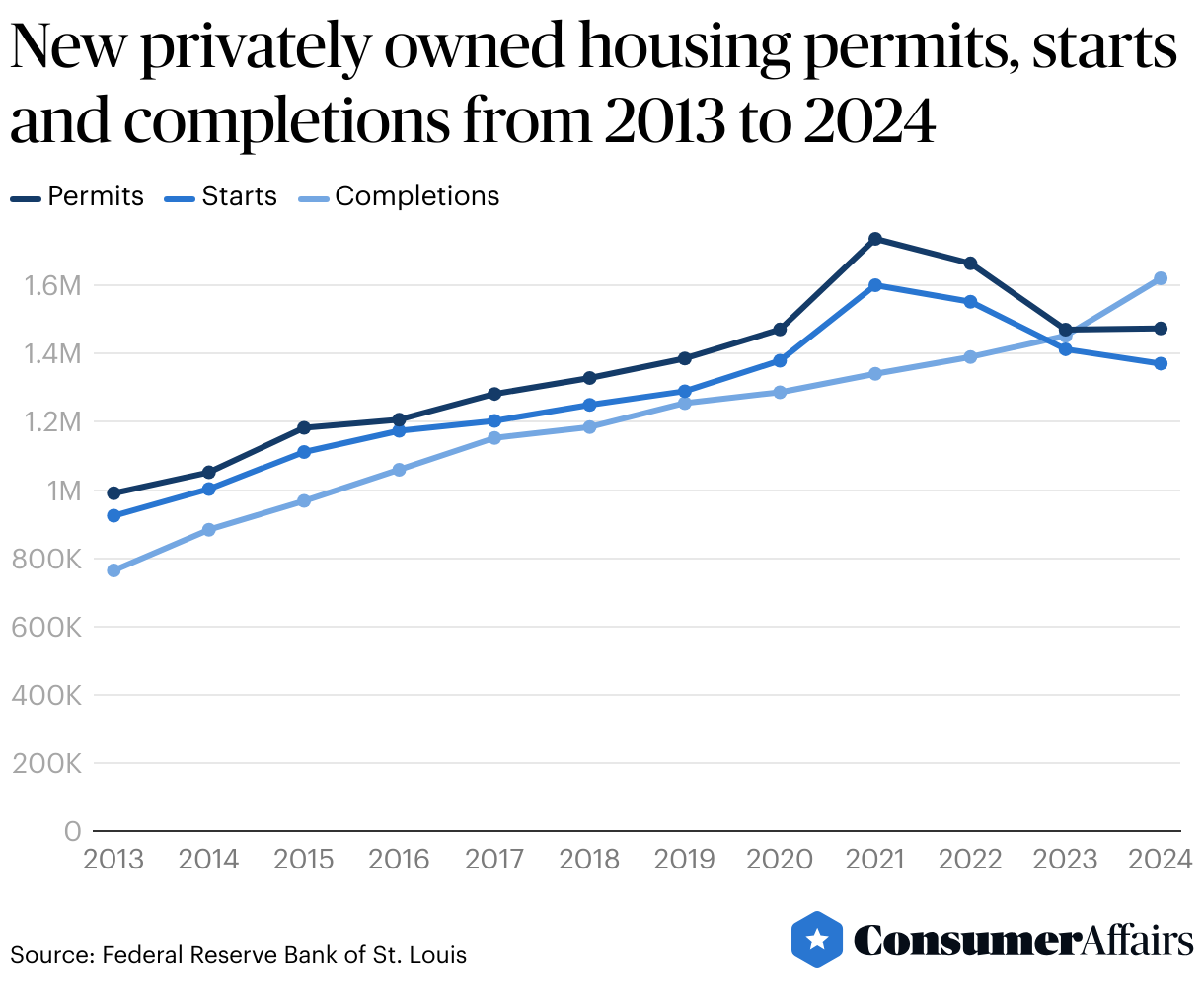
The volume of annual housing construction in the U.S. has increased significantly over the past 10 years when measured by three key metrics.
From 2013 to 2025, the number of privately owned housing permits issued annually jumped by over 38%, and the number of homes that started construction annually increased by nearly 43%.
But the most dramatic change was seen in the number of annually completed housing units, which skyrocketed by about 112% from 2013 to 2024.
New home construction by state
According to recent data compiled by the U.S. Census Bureau, Florida and Texas had the highest volumes of residential construction permits issued among all U.S. states in August 2025.
The states with the lowest numbers of new home construction permits issued in August that year were Wyoming (153,000), Rhode Island (143,000)and Alaska(90,000).
The U.S. Census Bureau’s latest full year (2024) of housing data reveals interesting state-by-state trends in residential construction.
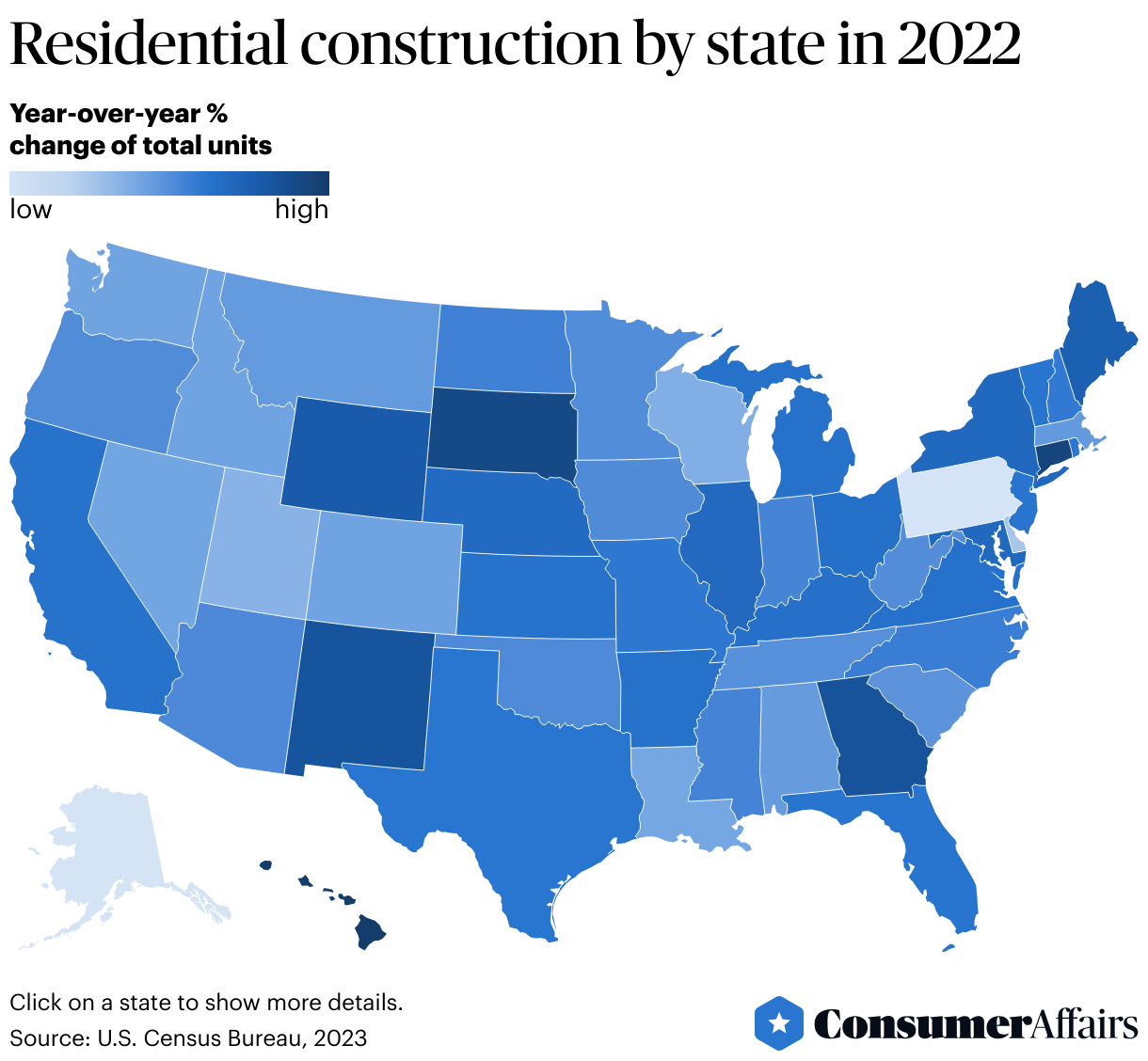
In terms of total privately owned housing units authorized for construction, Connecticut (+27%), Rhode Island (26%) and Hawaii (+12%) experienced the largest year-over-year increases throughout the U.S. from 2021 to 2024. Meanwhile, Pennsylvania (48%), Colorado (43%) and Utah (39%) saw the sharpest declines in total units authorized during that period.
Broken down by region, the South was home to the largest number of new privately owned housing units authorized in August 2025, with 59,318 units approved. This significantly outpaced the number of units authorized in the West (25,651), the Midwest (18,37614,294) and the Northeast (10,551).
Construction costs
The costs associated with building homes continue to run high. And the value of all that construction is growing, too. In fact, the overall value of construction throughout the U.S. in 2023 was approximately $1.98 trillion, which was about 7% higher than 2022’s figure of $1.85 trillion.
U.S. construction spending, meanwhile, exceeded an annual rate of $2,139 billion in July 2025, which was down slightly from June 2025, and down (.1%) from June 2024.
Certain materials and products are adding to the pricing pinch more than others right now. Copper base scrap, for instance, has experienced a significant price increase recently, as have concrete and cement products. Steel and lumber costs have been extremely volatile in recent years, too. Meanwhile, costs for heating, ventilation and air conditioning (HVAC) equipment jumped 37% from 2021 to 2025.
In 2022 and 2023, some of the more notable building material prices were:
- Crushed stone: $15.60 per metric ton (2023)
- Cement: $150 per metric ton (2023)
- Hard sawn wood: $675 per cubic meter (2022)
Average construction costs for single-family homes in the U.S have risen sharply in recent years. In 2024, the average cost was $428,215, which was a $130,000 increase from the average cost in 2020. A plurality of those construction costs in 2024 (24%) were spent on “interior finishes,” such as flooring, insulation and appliances.
Homebuilding price trends
Business intelligence firm Gordian provides sobering year-over-year data from 2022 to 2025 that demonstrate the sharp increase in construction costs and foreshadow the upward trajectory of homebuilding prices. Per Gordian:
- Nearly 86% of equipment costs rose by over 5%, with most increases coming from operating costs (like diesel prices).
- About half of labor wages increased by over 4%.
- The vast majority of construction materials’ prices went up substantially. The cost of construction materials increased by an average of 19%.
Gordian also reported that the average unit cost of several key construction components varied by the following percentages:
- Framing Lumber: 10% decrease
- Steel: 48% decrease
- Concrete Block: 50% increase
- Electrical conduit: 25% increase
- Insulation: 56% increase
FAQ
How many homes are built in the U.S. each year?
Over 1,608,000 privately owned housing units were built in the U.S. in 2025.
Where in the U.S. are the most houses being built?
According to the U.S. Census Bureau, the state where the most houses are being built appears to be Texas, which authorized the construction of over 14,273,000 privately owned housing units in 2025. This was almost double the number of houses that were built in California, despite the fact that Texas is the less populous of the two states.
Are construction costs still climbing?
According to Gordian, a business intelligence firm that specializes in the construction industry, 85.7% of construction equipment costs jumped by over 5% from 2022 to 2023. And the U.S. Census Bureau reported that total U.S. construction costs in February 2024 saw a year-over-year increase of nearly 11% from February 2023.
Article sources
ConsumerAffairs writers primarily rely on government data, industry experts, and original research from other reputable publications to inform their work. Specific sources for this article include:
- U.S. Census Bureau and U.S. Department of Housing and Urban Development, "Monthly New Residential Construction, August 2025." Accessed Oct. 9, 2025.
- United States Census Bureau, "New Housing Units Started in the United States." Accessed Oct. 9, 2025.
- United States Census Bureau, "Annual New Privately Owned Housing Units Authorized by State." Accessed Oct. 9, 2025.
- United States Census Bureau, "Permits by State." Accessed Oct. 9, 2025.
- Trading Economics, "United States Construction Spending." Accessed Oct. 9, 2025.
- U.S. Census Bureau, "Economic Indicators." Accessed Oct. 9, 2025.
- United States Census Bureau, "U.S. and World Population Clock." Accessed Oct. 9, 2025.
- U.S. Census Bureau and U.S. Department of Housing and Urban Development, "Monthly New Residential Construction, August 2025." Accessed Oct. 9, 2025.
- United States Census Bureau, "Business and Industry: Time Series / Trend Charts." Accessed Oct. 9, 2025.
- Federal Reserve Bank of St. Louis. "New Privately-Owned Housing Units Authorized in Permit-Issuing Places: Total Units (PERMIT)." Accessed Oct. 9, 2025.
- Federal Reserve Bank of St. Louis, "New Privately-Owned Housing Units Started: Total Units (HOUST)." Accessed Oct. 9, 2025.
- Federal Reserve Bank of St. Louis, "New Privately-Owned Housing Units Completed: Total Units (COMPUTSA)." Accessed Oct. 9, 2025.
- United States Census Bureau, "Permits by State." Accessed Oct. 9, 2025.
- Trading Economics, "United States Construction Spending." Accessed Oct. 9, 2025.
- Federal Reserve Bank of St. Louis, "Producer Price Index by Industry: HVAC and Commercial Refrigeration Equipment." Accessed Oct. 9, 2025.
- National Association of Home Builders, "Special Study: Cost of Constructing a Home, 2024 (January 2025)." Accessed Oct. 9, 2025.
- National Association of Home Builders, "Cost of Constructing a Home." Accessed Oct. 9, 2025.
- Gordian, "Construction Cost Insights Report: Q3 2025." Accessed Oct. 9, 2025.
- Gordian, "Concrete Block." Accessed Oct. 9, 2025.
- Gordian, "Framing Lumber." Accessed Oct. 9, 2025.
- Gordian, "Structural Steel." Accessed Oct. 9, 2025.
- Gordian, "Conduit." Accessed Oct. 9, 2025.
- Gordian, "Fiberglass Insulation." Accessed Oct. 9, 2025.
Figures